News · SoftBank Group Corp.
SoftBank introduces SB Energy before its first data center revenue
The prospectus doesn't just describe an IPO. It reveals how SoftBank is turning a gigantic AI infrastructure promise into a fundable asset-with OpenAI as the customer, Nvidia as the investor and conditional guarantor, and the market as the next source of capital.
Courtesy translation of the French original.
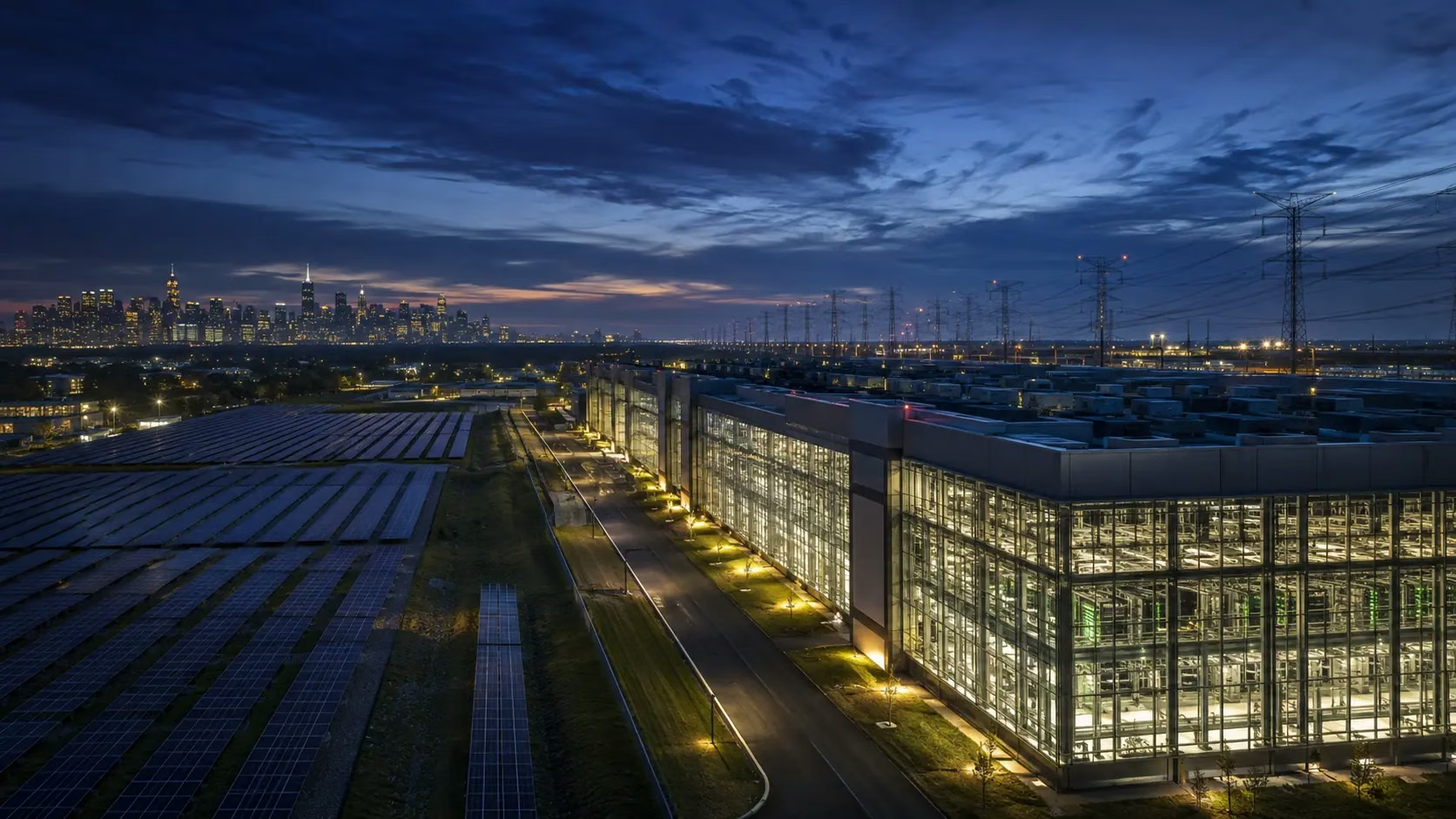
For the SoftBank Group shareholder, the interest in SB Energy's IPO is not in discovering a new peripheral stake. It is in seeing, almost line by line, how Masayoshi Son intends to finance the physical layer of his bet on artificial intelligence. SoftBank already owns the models through OpenAI, the computing architecture through Arm, and now a growing share of the electricity, land, and buildings that must power the whole thing.
The essentials
SB Energy, a subsidiary controlled by SoftBank, has filed its S-1 form and applied for a Nasdaq listing under the symbol SBE. The number of shares and the price have not yet been determined. The company claims $439 billion in future contracted revenue, including approximately $430 billion in data centers, even though no computing capacity is yet operational. The IPO therefore aims as much to raise capital as to gain market recognition for an asset currently buried within SoftBank.
Why this matters to SoftBank
SoftBank does not publish a separate valuation for SB Energy in its net asset calculation. As of June 30, 2026, the group had a net asset value (NAV) of 72.30 trillion yen, 83.11 trillion yen in assets, and 10.81 trillion yen in adjusted net debt. Arm alone accounted for 49.91 trillion yen after equity-backed financing. SB Energy falls into a much less transparent "other" category. A listing would create an observable price, could directly finance development, and reduce the project's reliance on the parent company's balance sheet alone. However, it would not eliminate SoftBank's guarantees or the circular economic links with OpenAI.
A huge order book, but not yet a profit and loss statement
The contrast is striking. SB Energy reports 8.8 GW-IT of contracted capacity: approximately 0.8 GW under construction and 8.0 GW under contract but not yet built. Its operational power portfolio reached 2.2 GWac of solar and storage, with an additional 2.5 GW under construction. In other words, the company is not without assets or revenue: it generated $138.7 million in revenue in the first half of 2026. But this revenue comes primarily from electricity. The data center business has not yet generated any significant revenue; The first lease start is expected in the fourth quarter of 2026 on the Cosmos campus in Texas.
The $439 billion backlog should therefore be interpreted as the face value of very long-term contracts, not as a receivable that can be collected tomorrow. The duration is precisely what makes the figure spectacular. It is also what makes it vulnerable: discounting several decades of rent, factoring in inflation, energy costs, maintenance expenses, and counterparty risk can yield a very different economic value than the stated amount.
The word that changes everything: "backlog"
OpenAI is a customer, partner, and future shareholder.
The PORTS-Pike campus in Ohio is slated to comprise 17 buildings and approximately 8 GW-IT. OpenAI has signed twenty-year leases there. This commercial visibility allows SB Energy to borrow and begin construction before commissioning. However, it also concentrates a considerable portion of the risk on a counterparty that is still heavily capital-intensive.
The alignment goes even further: OpenAI holds nearly four million warrants with a nominal exercise price of $0.01. Approximately 1.74 million are to be acquired or become acquired at the time the IPO price is set, with the remainder dependent on valuation thresholds. The prospectus thus transforms a strategic client into a potential beneficiary of the property owner's increased value. This is a rational approach to securing a substantial commitment; it is also a form of commercial cost paid in capital.
For SoftBank, this circularity deserves special attention. The group finances OpenAI, guarantees certain commitments from SB Energy, and controls the landlord who leases its infrastructure to OpenAI. Successful growth can create value on multiple levels. Conversely, a funding delay or weakness at OpenAI could simultaneously affect several of the holding company's assets.
Nvidia provides capital-and something rarer.
Nvidia has committed to acquiring $1.5 billion of non-voting Class N shares at the IPO price. A separate $1.5 billion prepaid contract provides for the delivery of securities calculated at a 10% discount to the IPO price. Its role doesn't end there: an Nvidia 8-K filing describes residual value guarantees linked to leases of approximately 4.25 GW of computing capacity at the PORTS-Pike campus.
The scope is significant, but not unlimited. Nvidia's initial cumulative obligation is capped at $105 billion; it is triggered in phases with the relevant leases and targets the difference between a minimum guaranteed value and the amounts recovered after certain defaults or OpenAI's insolvency. Support for approximately an additional 3.8 GW remains at Nvidia's sole discretion. This mechanism therefore transfers a specific portion of the value and counterparty risk; it does not guarantee the entire campus, the total project cost, or all of OpenAI's obligations.
The financing circuit, simply
- 1OpenAI promises the demand.Long-term leases create a backlog and provide visibility for lenders.
- 2Nvidia is backing an initial tranche.Capital, prepaid contracts, and guarantees capped at $105 billion on approximately 4.25 GW reduce some of the counterparty and residual value risk.
- 3SB Energy is building.The company raises debt and equity to transform contracts into operational capabilities.
- 4SoftBank retains control.An IPO can solidify value and share funding without relinquishing strategic direction.
The $3.2 billion loss primarily reflects the price of options.
SB Energy posted a net loss of $3.21 billion in the first half of 2026, compared to revenues of $138.7 million. This consolidation is dramatic, but incomplete: approximately $2.57 billion comes from the non-monetary revaluation of warrants and $589.5 million from stock-based compensation. The accounting loss alone, therefore, does not measure the operational cash burn. It does, however, serve as a reminder of how much the capital allocated to partners and employees can dilute SoftBank's value.
The Cosmos campus illustrates the other side of the risk. A subsidiary linked to SoftBank is to lease the site for fifteen years, for approximately $2.5 billion in aggregate rent. SoftBank Group Capital guaranteed the tenant's obligations, for an anticipated exposure of nearly $2.9 billion. Even after the IPO, certain financial promises thus remain tied to the group.
What an IPO can create
A public price for an asset not separately valued, independent access to equity, better isolated borrowing capacity, and quarterly reporting discipline.
What it doesn't eliminate
Construction risk, focus on OpenAI, dilution through warrants, SoftBank guarantees, and the mismatch between nominal backlog and cash flow.
Opulion Reading: SoftBank Builds Infrastructure, Then a Listed Asset
The financial innovation isn't the IPO itself. It lies in the sequence. SoftBank first assembles the customer, the chip supplier, the land, the electricity, and the long-term commitments. It then offers the market a simpler object to finance: an infrastructure company with contracts, physical assets, and a deployment schedule.
If the operation is successful, SoftBank can retain control while having part of the program financed by new shareholders. SB Energy's value will become visible in the sum of its parts. If the asking price is too ambitious, the prospectus will nonetheless give investors a unique tool to measure the group's true commitment to data centers.
Our conclusion is therefore nuanced: the S-1 provides remarkable evidence of contract demand, but not yet proof of profitability. For SoftBank shareholders, the next decisive figure is not $439 billion. It is the first lease payment, then the return on invested capital after deducting the cost of debt.
Things to watch
- 1Points to watchThe price range, the number of shares, and SoftBank's exact dilution;
- 2Point to watchThe proportion of IPO proceeds allocated to projects rather than intragroup repayments;
- 3Point to watchthe effective start of Cosmos's lease payments in the fourth quarter of 2026;
- 4Point to watchthe termination clauses, guarantees, and indexation of OpenAI contracts;
- 5Point to watchThe evolution of the guarantees retained by SoftBank after the listing.
Sources
- SoftBank Group - announcement of the public filing of the S-1, September 2, 2026.
- SEC - SB Energy, Form S-1, Filed September 1, 2026.
- SEC - Nvidia, Form 8-K on PORTS-Pike Warranties, August 17, 2026.
- Nvidia - Announcement of Guarantees and Investment in SB Energy, August 17, 2026.
- SoftBank Group - Official Calculation of NAV as of June 30, 2026.
Share this article