News · Scottish Mortgage Investment Trust PLC
Scottish Mortgage: ASML and TSMC sell more, but their margins move in opposite directions
The trust owns both the equipment supplier and the chipmaker using its machines. Their results show how one investment cycle produces different economics.
On 14 and 15 October, two Scottish Mortgage holdings reported higher quarterly sales. ASML’s gross margin rose. TSMC’s fell. Demand is growing, but the costs arrive at different stages.
Scottish Mortgage is a listed company that invests in other businesses. Through ASML and TSMC, its shareholders own two links in the same industrial chain: the machines that make chips and the factories that use them.
One industrial expansion supports two business models
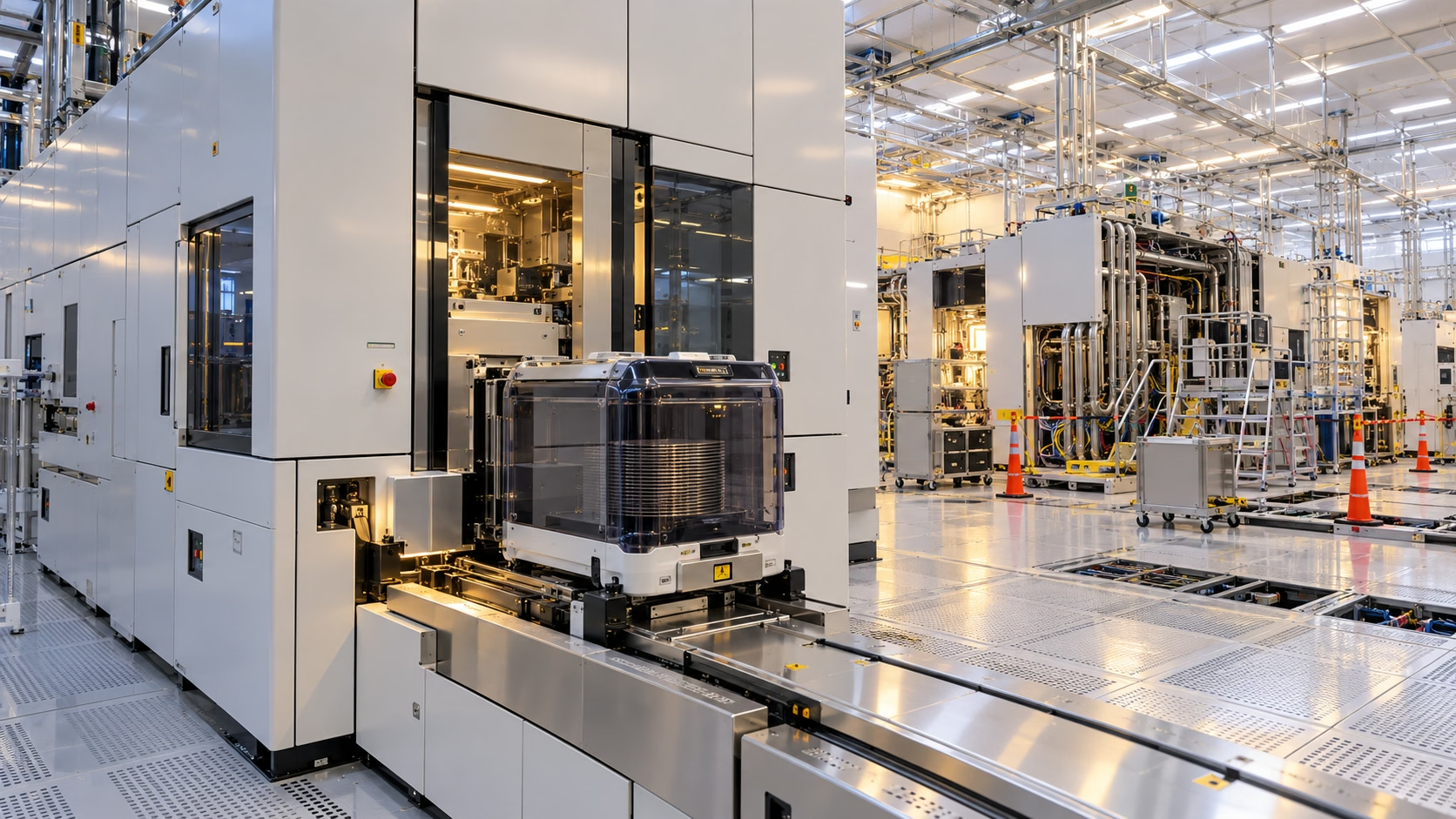
ASML sells lithography systems, used to create circuit patterns on silicon wafers. TSMC manufactures chips from its customers’ designs. One supplies a tool. The other must turn that tool into profitable production.
At 30 September, TSMC accounted for 6.5% of Scottish Mortgage’s assets and ASML for 2.8%, according to the official factsheet. Applied to £18.67bn of total assets, those weights imply approximately £1.21bn and £523m respectively.
These are minority investments with a combined estimated value of £1.74bn. The amounts use rounded published inputs. The chart puts the positions in the context of the whole portfolio.
- ASML 2.8% Approximately £523m
- TSMC 6.5% Approximately £1.21bn
- Other assets 90.7% Remaining investments and liquidity
Two company names do not automatically diversify an industrial risk. Part of both businesses depends on the same willingness among customers to fund additional capacity.
ASML earns from new machines and the machines already in service
ASML’s third-quarter sales reached €11.66bn, compared with €9.33bn in the previous quarter. That is an increase of about 25%. Gross margin rose from 54% to 57.5%.
Gross margin is the share of sales left after direct production costs, before research, administration and other expenses. It helps track product economics without confusing that profit with net income.
On 14 October, chief executive Christophe Fouquet attributed the stronger-than-expected margin partly to productivity upgrades sold for machines already installed. Those upgrades can lift a factory’s output without waiting for another factory to be built.
TSMC’s margin moved the other way. The chart compares each company with its own previous quarter, rather than with a common profitability target.
TSMC sells more while absorbing the cost of a production ramp
TSMC reported US$46.72bn of revenue, 16.2% more than in the second quarter. Yet gross margin fell from 67.7% to 66.4%. Its management report primarily attributes the dilution to the initial ramp-up of 2 nm, its new manufacturing generation.
Why does selling more fail to preserve the margin? A new process has to build volume and settle into efficient operation. Equipment and teams already cost money before production matches an established process’s efficiency. TSMC does not publish a breakdown isolating each component of the cost.
Our 4 September article about TSMC’s factory expansion asked what returns the new capacity would produce. This quarter supplies an early operating example: higher sales can coexist with a lower margin.
A lower margin can still leave more cash
The margin describes the income statement. Free cash flow describes cash generated after capital expenditure during the quarter. They can move in different directions.
TSMC’s free cash flow rose from NT$287.36bn to NT$476.56bn. Operations generated more cash while capital expenditure fell from NT$496bn to NT$443.21bn. The chart shows the third-quarter calculation.
Scottish Mortgage shareholders therefore have two separate questions to track: the profitability of sales and the capital needed to generate them. The label “AI” answers neither question on its own.
What we do not know
On 15 October, TSMC chief financial officer Wendell Huang said the 2 nm ramp would continue into the fourth quarter. Management guides to a gross margin of 65% to 67%. Results in early 2027 will provide the next quarterly comparison.
The utilisation and multi-year returns of new capacity remain to be established. ASML also reports customers’ interest in placing orders for distant years. There is no single date for knowing whether those intentions become firm orders and deliveries.
How we counted
Holdings weights use the trust’s total assets at 30 September, not its net assets. Quarterly comparisons retain the published currencies: converting them into euros would add an exchange-rate effect to the industrial movement being studied. ASML’s quarter ended on 27 September and TSMC’s on 30 September. ASML’s net income also includes an investment gain, separate from the margin shown here.
Sources
Share this article