Analysis · Scottish Mortgage Investment Trust PLC
According to SemiMedia, TSMC is building nearly twenty plants: Scottish Mortgage's industrial gamble
According to SemiMedia, some of TSMC's customers still lack capacity. For Scottish Mortgage, in which TSMC is the largest listed holding, the signal is as enticing as it is dangerous: demand validates the technological gap, but expansion requires flawless industrial execution.
Courtesy translation of the French original.
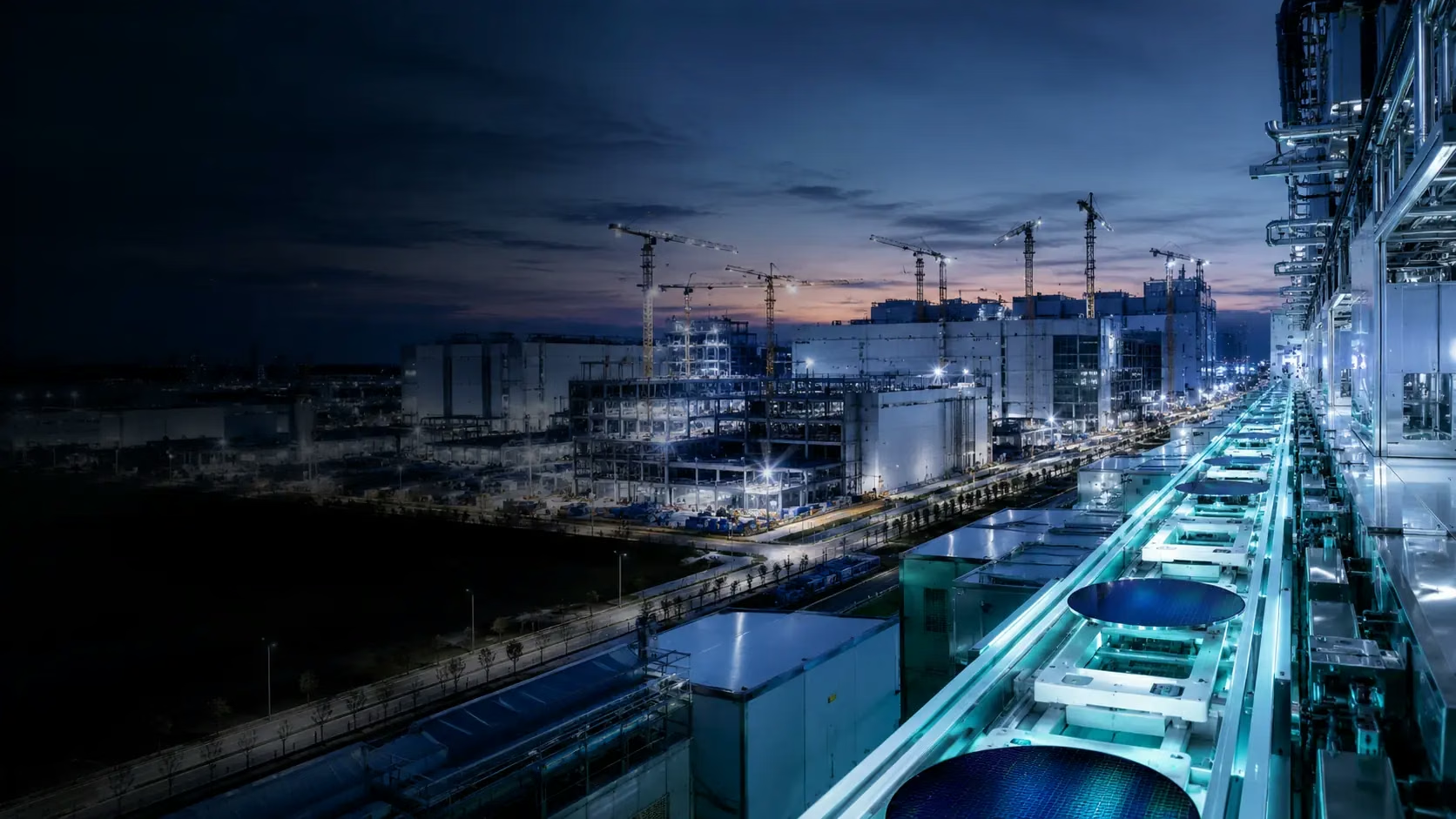
The curiosity begins with an industry paradox reported by SemiMedia: how can a company build nearly twenty manufacturing sites while leaving some customer needs unmet? The answer lies in the extraordinary nature of the computing demand for artificial intelligence, but also in the long lead time of a "fab." For the Scottish Mortgage shareholder, this tension matters more than the spectacular number of construction sites.
Summary in 30 seconds
The signal. The media outlet SemiMedia reports comments from Cliff Hou, TSMC's chief operating officer: the estimated equipment needs to meet 2026 demand have reportedly increased from an index of 1 at the end of 2025 to 1.5 after the first quarter, then to 1.9 in July. Approximately twenty factories are under construction, including thirteen in Taiwan and five or six overseas.
The holding read. TSMC accounted for 6.9% of Scottish Mortgage's £16.66 billion in assets as of July 31, or approximately £1.15 billion. This is its second-largest holding, after SpaceX, and its largest listed holding. Scarcity can support utilization and pricing power; The response through capital can absorb part of it.
The limit. The figure of twenty factories comes from a trade publication quoting an executive, not from a regulatory filing detailing each site. We treat it as an operational signal, not as an audited inventory.
A direct lever in Scottish Mortgage
A hypothetical 10% change in TSMC's share price would, all other things being equal, correspond to approximately 0.69% of the trust's gross assets. But the portfolio also holds Nvidia, ASML, and Anthropic: the economic exposure to the AI cycle is more concentrated than TSMC alone. The chipmaker's factories are a gateway between several of these holdings.
Scarcity is not an accident: it is the product
Manufacturing at the most advanced nodes requires accumulated processes, machines, software, materials, and expertise. In the second quarter, TSMC generated 77% of its wafer revenue using technologies of 7 nanometers or less. 3 nm accounted for 30%, and 5 nm for 33%. This mix explains why simply adding a building isn't enough: it requires qualifying processes, installing equipment, recruiting, achieving high yields, and often integrating advanced packaging.
The published results reinforce the demand signal. Second-quarter revenue reached NT$1,270.4 billion, up 36% year-over-year; net income increased by 77.4%. TSMC was guiding third-quarter revenue toward NT$44.6 billion to NT$45.8 billion, with a gross margin of 65% to 67%.
These figures are factsTo deduce that all twenty factories will produce at the same output or that margins will remain at that level would be an unproven inferenceNew foreign sites may cost more; bottlenecks shift to construction, labor, electrical connections, or suppliers.
The dual economics of expansion
Scarcity supports value
Demand above capacity can support factory utilization, pricing power and the value of TSMC, Scottish Mortgage's largest listed holding.
Capacity consumes value
Nearly twenty construction projects require massive investment. Overseas sites, qualification delays and new bottlenecks could reduce margins if returns fail to match those of established fabs.