Analysis · HAL Trust
At HAL, TKH becomes a real-world test of value creation
The Dutch holding company owns 10.2% of TKH. Shareholders have approved the separation of Electrification - but neither the form, the price nor the final timetable is yet known.
Courtesy translation of the French original.
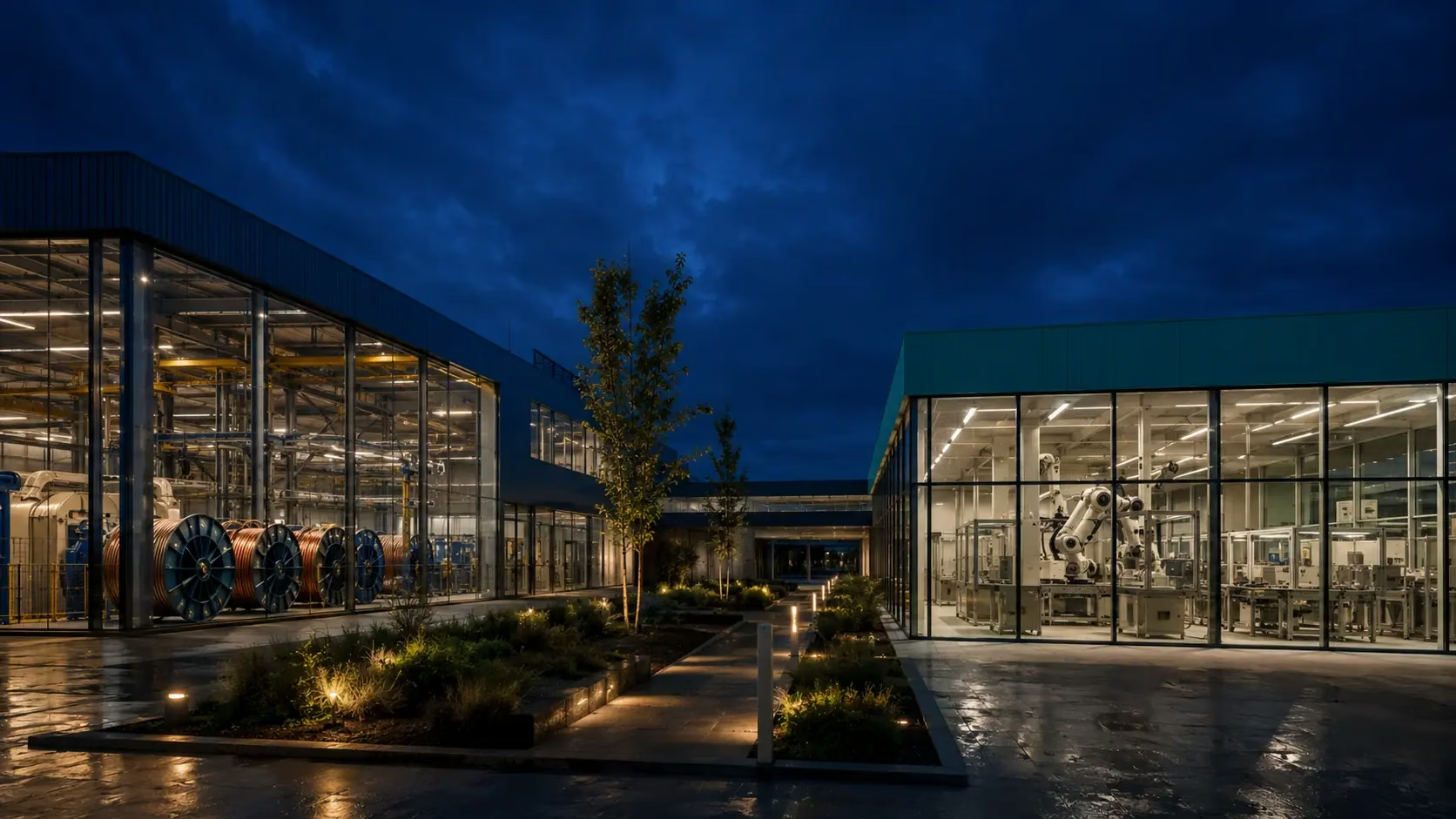
HAL Trust owns 10.2% of TKH Group, a listed stake valued at €189 million in its report as of June 30, 2026. On September 3, TKH shareholders approved the separation of the Electrification business. The principle is therefore settled; the economic form of the transaction remains to be determined.
What the September 3 vote decided
In summary
TKH wants to separate its rapidly growing power cable business from its automation business. Two options are being considered simultaneously: a public transaction - IPO, spin-off, or direct listing - and a private sale. For HAL, the stakes are twofold: greater transparency could reveal value, while the proceeds from a potential sale could be reinvested by TKH in automation or returned to shareholders. However, the project remains optional, flexible, and subject to separation costs.
Why this matters to HAL Trust shareholders
TKH is still a small holding within the HAL group: €189 million compared to a published net asset value of €17.626 billion, or approximately 1.1%. However, the stake increased from €154 million at the end of 2025 to €189 million at the end of June, while HAL's shareholding rose from 9.9% to 10.2%. Crucially, this holding demonstrates a core competency of a holding company: recognizing an overly complex structure, supporting its simplification, and allowing each asset to find the owner or market that best values it.
What TKH is really trying to separate
The TKH name now encompasses two industrial sectors. Automation combines industrial vision, automated machines, and software. Electrification manufactures cables for three main uses: offshore wind farms, onshore power grids, and specialized applications in robotics, medicine, and industry.
These activities do not have the same customers, capital requirements, order cycles, or valuation benchmarks. An industrial camera and a submarine cable are not sold in the same way. Automation relies more on intellectual property, software, and high-margin niches. Electrification requires factories, inventory, heavy capacity, and large-scale project management.
TKH believes these differences justify two independent companies, each with its own management, strategy, and capital allocation framework. In 2025, the business to be separated generated €522.2 million in revenue, had €626.7 million in assets, and a €478.2 million order backlog. Approximately 1,371 full-time equivalent positions are expected to be affected by the separation.
Why the timing is right
Electrification is not declining because it is detached. It is accelerating. In the first half of 2026, its revenue reached €328.2 million, representing organic growth of 33.3%. Its adjusted EBITDA increased by 90% to €41.5 million, and its margin reached 12.6%, compared to 8.9% a year earlier. The order book rose to €507.8 million.
The Eemshaven plant, built for inter-array cables for offshore wind farms, is improving its efficiency and production. On the onshore side, grid operators must invest heavily to accommodate electrification, renewables, and new uses. TKH indicates that its framework agreements signed in onshore energy represent €1.4 billion, not included in the published order book.
This profile could attract investors specializing in electrical infrastructure or an industrial buyer willing to finance growth. Conversely, a conglomerate combining automation and cables may be valued at a complexity discount. The separation thus attempts to transform an industrial difference into greater financial clarity.
The Value Mechanism for HAL
The dual process is the most intelligent part of the project. By simultaneously preparing a public offering and a private sale, TKH seeks to retain an option. A listing can offer a market price and leave shareholders exposed to both companies. A sale provides immediate cash and transfers the industrial risk to the buyer. The optimal outcome will depend on the price, terms, and capital that TKH wishes to retain.
In an IPO, new shares could be issued, existing shares sold, or both. In a spin-off or direct listing, TKH shareholders could receive shares in the Electrification business. TKH could also temporarily retain a stake and certain governance rights. For HAL, these options are not equivalent: one generates cash for TKH; another creates two listed companies; a third leaves an intermediate structure.
Can a small position really matter?
At €189 million, TKH represents only about 1.1% of HAL's net asset value. Even a significant revaluation would therefore have a limited effect on the holding company's NAV compared to Boskalis, Vopak, or SBM Offshore. This is the quantitative limitation of the issue.
But size doesn't diminish interest. The published stake increased from 9.9% to 10.2%, and HAL reclassified it in 2026 from its cash portfolio to listed investments. This treatment suggests a more strategic approach than a simple financial investment. The separation could become an initial test: will HAL remain a passive market shareholder, increase its position, or support one of the two entities over the long term? No such intention has been made public at this stage.
The Hidden Costs of Simplification
Creating two companies does not generate value for free. IT, legal, insurance, licensing, payroll, and certain warranties remain shared. TKH plans transitional agreements, followed by their termination. Governance, branding, and core functions will also need to be duplicated. Electrification's historical data is unaudited and does not necessarily reflect its future standalone costs.
The project itself remains remarkably flexible. The approval covers a separation under conditions to be determined later by the Executive Board, with the approval of the Supervisory Board. TKH states that there is no certainty regarding the method, scope or timetable. The objective announced in September 2025 was to reach substantial milestones within twelve to eighteen months, but that indication remains subject to market conditions.
The Creator Scenario
A competitive transaction properly values Electrification, funds Automation's growth, and returns surplus capital, while autonomous costs remain contained.
The Destroyer Scenario
An unfavorable market imposes a low price, separation costs spiral out of control, and the capital received is reinvested in less profitable acquisitions.
Opulion Reading
For the HAL investor, TKH is not yet a major source of net asset change. However, it is a clear laboratory for what an investment firm should do: distinguish between operational growth and financial value creation, look at the price rather than just the narrative of "simplification," and monitor cash flow after the transaction.
The vote, now secured, is only the beginning. The real event will be the announcement of the format, price and allocation of the proceeds. Until those three elements are known, talk of "unlocked value" remains hypothetical. The separation opens a door; it does not yet guarantee what lies beyond.