News · Gimv NV
Gimv reshapes its portfolio: Anchor heads towards 15% as Equine Care expands in the US
Batenburg automates factories and power systems. Equine Care treats horses in specialist hospitals. Two deals announced on the same day reveal the two ways in which Gimv now intends to compound portfolio value.
Courtesy translation of the French original.
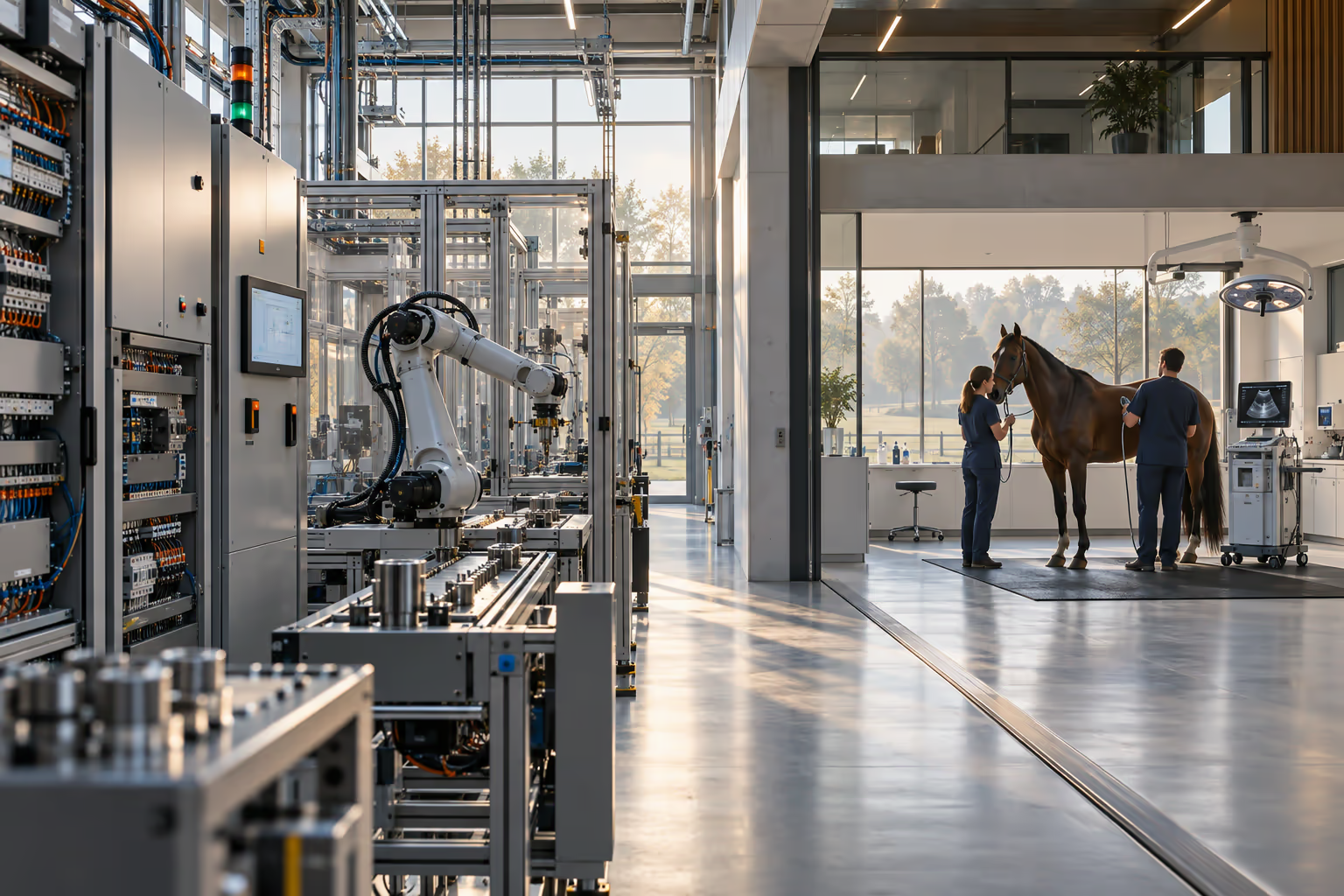
An electrical cabinet controlling a production line and an imaging suite designed for a horse appear to have little in common. Yet on 9 September 2026, these two operating worlds told the same story to Gimv shareholders.
In the morning, Gimv Anchor announced the acquisition of a stake in Batenburg Techniek, a Dutch group that designs, installs and maintains electrification and automation systems. A few hours later, Rood & Riddle, described as the largest privately owned equine hospital in the United States, agreed to join Equine Care Group, a Gimv holding focused on veterinary medicine for horses.
Both prices are confidential. The acquired percentages are undisclosed. A superficial reading would therefore stop at two transaction announcements without financial terms. The useful information for Gimv shareholders lies elsewhere: Batenburg completes a permanent-capital pocket expected to represent approximately 15% of the portfolio, while Equine Care continues an international consolidation strategy in a business that Gimv had already placed among its fifteen largest holdings.
Batenburg does not sell one machine
Batenburg is easier to understand through a concrete problem. A food plant wants to reduce energy consumption without stopping production. A network operator needs to add electrical capacity in a congested region. A manufacturer wants to automate a manual process, connect its equipment to software and protect the installation against cyber intrusion.
Batenburg brings together the engineers, software, equipment and on-site work required to solve such problems. It is therefore neither a simple component distributor nor a manufacturer dependent on one product. The group employs more than 1,300 people across five divisions and combines two broad businesses.
The first is industrial automation. Batenburg provides electrical and software engineering, data intelligence, robotics, machine vision, simulations and industrial cybersecurity. Its teams work in food and beverages, chemicals, pharmaceuticals, water infrastructure, machine building, energy, marine and offshore markets and horticulture. Solutions range from production-line control to digital greenhouse management.
The second is electrification. Batenburg supplies and integrates transformers, switchgear, insulators, cable accessories, energy-storage systems, charging equipment and power-quality solutions. The group also supports grid upgrades and technical building installations.
The economic product is therefore a combination of components, engineering, software, installation, maintenance and on-site support. The more Batenburg understands a customer's critical processes, the more costly and risky it becomes for that customer to change integrator. This proximity can support recurring service revenue, without making the business independent of industrial investment cycles.
Make the factory work
Batenburg designs and integrates the systems that operate production processes.
Distribute reliable power
The group equips grids, industrial sites and buildings adapting to the energy transition.
Stay close to the customer
Initial engineering can develop into a durable relationship through maintenance and future upgrades.
Company examples make the model tangible. Batenburg is replacing an evaporation system in a dairy plant without interrupting production, modernising equipment at a historic brewery and designing an all-electric headquarters despite grid constraints. Value does not come from selling an isolated object. It comes from making hardware, software and a real industrial process operate together.
This description also explains Gimv's interest. Electrification, labour scarcity, factory digitalisation and grid congestion create durable needs. Batenburg reports average annual revenue growth of approximately 10% over the past decade. The release does not separate organic growth from acquisitions and discloses neither margins, debt nor cash flow.
Anchor changes Gimv's holding period
Batenburg is the third investment by Gimv Anchor Investments, after Cegeka and Azelis. Anchor is a joint venture between Gimv and WorxInvest, designed to supply very long-term capital to established European businesses. It can take majority or active minority positions, invest between €40 million and €400 million and participate in governance without imposing a traditional private-equity fund exit date.
The distinction matters. Gimv's historical business is to acquire, develop and then sell holdings. Exits release capital, crystallise gains and finance new investments. Anchor adds another logic: holding businesses for longer when they can reinvest earnings and compound value over time.
At 30 June, Anchor represented €277 million, or €277 million divided by €2,407 million, equal to 11.5% of Gimv's total portfolio. In its 3 September presentation, Gimv still described an unnamed third investment in technical services for industry and infrastructure, at the heart of automation and the energy transition. That description matches Batenburg. This is an Opulion inference, very strongly supported by the announcement six days later.
The same presentation states that the three investments would bring the total Anchor portfolio to approximately €500 million. About 75% would be invested from Gimv's balance sheet, equivalent to approximately €375 million and 15% of the company's portfolio. The remainder comes from capital associated with the joint venture.
This scale changes the interpretation of Batenburg. The published €342 million is the target company's annual revenue. It says nothing about its price, enterprise value or Gimv's cheque. The release expressly says that no additional financial detail will be disclosed. The Anchor presentation does show, however, that the third transaction completes a segment large enough to influence the listed company's portfolio duration and liquidity profile.
For shareholders, the potential benefit is capital that can stay invested for as long as the business continues to create value. The counterpart is less frequent observable pricing and fewer exits. Without Batenburg's entry price, operating profit or debt, neither the expected return nor the immediate effect on Gimv's net asset value can be calculated.
Equine Care sells treatment, diagnostics and medical expertise
Equine Care Group is a healthcare-services business, but its patient is the horse. The group was formed in 2021 around Equitom, Global Medics and an ambulatory veterinary practice. It now brings together hospitals, clinics, vets who travel to stables, reproductive services, laboratories, nutrition and supplement activities, research and education.
Its revenue model is based on several services: consultations, surgery, imaging, laboratory testing, dental and orthopaedic care, reproduction, sport-horse medicine, ambulatory visits, medicines and specialist products. Some interventions are urgent and episodic. Others create a more regular relationship with breeders, owners, trainers and stud farms.
Before Rood & Riddle, Gimv said that Equine Care treated more than 50,000 horses each year and had expanded through more than 30 acquisitions. The group is also building hospitals in underserved regions. Its proposition is not merely to collect practices. It is to share expensive equipment, specialists, laboratories, clinical knowledge, education and research while keeping veterinarians involved in governance.
Rood & Riddle adds an established American platform. Its sites in Lexington, Kentucky, Saratoga Springs, New York, and Wellington, Florida, are located in three major centres of breeding and equestrian sport. The business provides surgery, internal medicine, CT, MRI and PET imaging, reproduction, podiatry, dentistry, sport-horse medicine, laboratory and pharmacy services.
The horse
Hospitals, surgery, imaging, internal medicine and emergency care.
Owners and professionals
Breeders, stud farms, trainers, teams and owners pay for care.
Equine Care Group
Equipment, specialists, research and purchasing can be shared while clinics retain their local identity.
The combination has not yet completed. The parties have signed a partnership agreement, but closing remains subject to legal documentation, regulatory filings, approvals and customary conditions. Price, financing and Rood & Riddle revenue are undisclosed.
Why Rood & Riddle matters without a price
When Gimv announced its indirect minority investment in Equine Care in November 2025, it said the transaction would make the company one of its ten largest holdings. At 30 June 2026, Gimv's ten largest positions collectively represented 50.3% of the portfolio, and no individual holding exceeded 10%. At that date, however, Gimv's presentation ranks Equine Care between 11th and 15th. The holdings ranked 11th to 15th are worth €320m together, or 2.7% of the portfolio each on average.
These data do not permit a precise value to be assigned to Equine Care. They establish that the event concerns a materially important holding rather than an immaterial acquisition buried inside a subsidiary. They also show the transparency limit: shareholders know that Equine Care ranks between 11th and 15th in Gimv's portfolio but do not know its exact weight or the cost of Rood & Riddle.
The industrial significance is clearer. After an initial US entry through Salado Equine Medical Center, the Rood & Riddle combination adds three locations, advanced medical specialties and an American reputation. Equine Care is moving from opportunistic expansion towards the visible construction of a transatlantic network.
Execution is the central risk. A care platform cannot be consolidated like a chain of stores. Value depends on veterinarians, reputation, clinical quality and customer trust. Economies of scale may come from purchasing, laboratories, equipment, education and administrative functions. They must not weaken the clinical autonomy that persuaded practitioners to join the group.
Two engines, one capital-allocation question
The two 9 September announcements make Gimv's strategy easier to read.
With Batenburg, Gimv is building a pocket of long-duration holdings in established, profitable businesses capable of growing with founders, families or management teams. The intended value creation comes from durable growth, governance and reinvestment without a required sale date.
With Equine Care, Gimv is supporting a healthcare platform that acquires specialist businesses, opens new sites and extends its international network. Value creation here depends more directly on integration, network density, shared equipment and the ability to retain key professionals.
Batenburg in Anchor
Hold for longer and support the governance of businesses capable of compounding value.
Equine Care and Rood & Riddle
Bring together clinics, specialists and infrastructure to build an international platform.
Allocation discipline
Asset quality is visible; Gimv's return will depend on the price paid, debt and future cash flows.
The combination can make Gimv more resilient. Long-duration capital reduces dependence on an exit calendar, while traditional platforms can continue to crystallise value through development and disposals. It can also make the portfolio harder to read because a growing share of value resides in unlisted assets whose entry prices and individual performance are only partly disclosed.
The useful conclusion is therefore not that Gimv bought automation and equine healthcare on the same day. It is that the listed company now operates two value-creation clocks. One moves slowly through permanent capital and reference minority shareholdings. The other accelerates platforms through acquisitions and international expansion.
The next evidence to seek is specific: Batenburg's fourth-quarter closing, the Anchor segment's development in the next accounts, completion of Rood & Riddle, Equine Care's organic growth, its debt and the acquisitions' contribution to earnings. Until those figures appear, the strategic architecture is visible but its return remains to be demonstrated.
Sources
- Gimv: Anchor investment in Batenburg Techniek, 9 September 2026
- Gimv: investor presentation and interim results, 3 September 2026
- Gimv: interim report at 30 June 2026
- Gimv: Gimv Anchor Investments strategy
- Batenburg Techniek: businesses, solutions and markets
- Gimv: Rood & Riddle and Equine Care Group agreement, 9 September 2026
- Gimv: minority investment in Equine Care Group, 27 November 2025
- Equine Care Group: business model, activities and members
- Rood & Riddle Equine Hospital: locations and services
Share this article