Analysis · Groupe Bruxelles Lambert SA
GBL has sold more than EUR 5 billion of assets. What it is buying instead changes the holding company.
At 30 June, 54% of the portfolio is still listed. Yet Rayner, BUKO and Recordati tell of a new phase: more control, larger tickets, and healthcare as the new centre of gravity. The half-year report lets us measure where that transformation creates value.
GBL's 2026 half-year report runs past a hundred pages. Its most important idea fits in one sentence: the company is no longer only simplifying its portfolio, it is gradually changing the way it owns and governs the businesses it invests in.
One could of course start with net asset value: EUR 13,079 million at 30 June, or EUR 100.77 per share. Or with the consolidated net result, group's share: EUR 53 million. Or with the discount: 20.9%. All those figures are accurate. None of them, on its own, is the right way in.
The best starting point is the flow of capital. Since 2024, GBL has sold more than EUR 5 billion of assets. The company publishes the detail: adidas for EUR 1.7 billion in 2024; GBL Capital for EUR 1.7 billion, SGS for EUR 0.8 billion and Umicore for EUR 0.3 billion in 2025; then Umicore for EUR 0.3 billion, Concentrix for EUR 0.1 billion and non-core asset classes for EUR 0.2 billion in the first half of 2026.
Over the same period, the group accelerated a shift begun long ago: less capital in large listed minority stakes, more in private companies whose trajectory it controls or jointly controls.
Rayner, BUKO and Recordati give the direction. These are not merely three new holdings: all three answer the same specification, a leading position in its market, organic growth, consolidation potential, and above all a role of control or joint control for GBL.
A break with the Albert Frère era? Not really
An impression the 2026 deals could easily create needs correcting. GBL has never been a passive shareholder. Under Albert Frère, the group did not need to own 51% of a company to want to shape its trajectory.
The 2012 annual report is explicit. Among its governance criteria, GBL set out the wish to be, ideally, the first or second shareholder, to play an active role on the board and its committees, and to take part in major strategic decisions as well as in management appointments and compensation. The group then held eighteen seats on the boards of its six main investments.
The real difference with 2026 is therefore less a move from passive to active shareholder than a move from influence to more control. We told that trajectory in detail in forty-four years of capital allocation at GBL.
Johannes Huth, who became managing director on 2 May 2025 after twenty-five years at KKR, is accelerating that logic. But he does not arrive on a blank page: the roadmap he is executing was announced by the board at the Strategic Update of November 2024.
Before looking at what GBL buys, look at what is disappearing
Portfolio simplification is not a slogan. GBL has genuinely reduced several positions that long defined the group. Umicore left the portfolio in February 2026 for EUR 0.3 billion. Concentrix was cut from 14.4% to 4.5% of the capital in April, for EUR 0.1 billion of proceeds. Add to that the gradual winding down of GBL Capital, now classified as a non-core asset class, and the exit from third-party asset management.
But to say the old portfolio has already gone would be wrong. Listed assets still amount to EUR 6,556 million at 30 June.
| Listed holding | Value at 30 June 2026 | Share of portfolio |
|---|---|---|
| SGS | EUR 2,877m | 23.5% |
| adidas | EUR 1,140m | 9.3% |
| Pernod Ricard | EUR 1,101m | 9.0% |
| Imerys | EUR 980m | 8.0% |
Those four lines alone account for close to half the total portfolio.
The difference with what GBL now buys matters. In a large listed minority stake, the group can influence governance, engage with management and weigh on strategic decisions. In a controlled or jointly controlled asset, responsibility is of another order: choice of management, pace of acquisitions, financing structure and the timing of value creation become far more directly tied to the owner.
The report sets this out in black and white. For direct private assets, GBL targets mainly controlled or jointly controlled stakes, with equity investments between EUR 500 million and EUR 1.5 billion. In other words: fewer lines, larger ones, and more responsibility for their trajectory.
Rayner, BUKO and Recordati follow the same playbook
Rayner
Joint control with CVC, around 45% economic interest, in British ophthalmic medtech. Intraocular lenses and cataract surgery equipment, sold in more than 80 countries across six continents. Sales up 18%, EBITDA up 19%.
BUKO Group
Majority stake of around 95%, with management reinvesting alongside GBL. Temporary traffic management and road safety solutions, around EUR 230 million of sales, in the Netherlands, Sweden, the United Kingdom and Germany. Closed on 8 July, after the reporting date.
Recordati
Voluntary tender offer launched with CVC Capital Partners Fund IX to take the Italian pharmaceutical group private. The amount is a ceiling, not a commitment. At 30 June, EUR 349 million of shares had already been bought in the market.
The accounting detail is telling: Recordati still sits among the report's listed assets, while GBL's whole thesis consists precisely in taking it off the market to become an active co-owner.
The common thread is therefore neither healthcare nor services. It is control. The company seeks platforms where it can act on governance and accelerate growth through acquisitions. That brings GBL closer to a permanent-capital private equity model, without the life-span constraint of a classic fund.
Healthcare has already become far more than a theme
There is a second transformation in the portfolio: the sector concentration forming around healthcare.
Affidea is worth EUR 2,169 million in GBL's net asset value. Sanoptis, EUR 1,208 million. Rayner, EUR 442 million. The Recordati shares already bought, EUR 349 million. Together those four exposures represent about EUR 4,168 million, a little over 34% of the EUR 12,231 million portfolio.
- Affidea 17.7% imaging, diagnostics and outpatient care
- Sanoptis 9.9% ophthalmology clinics
- Rayner 3.6% implants and eye surgery equipment
- Recordati, shares already held 2.9% specialty pharmaceuticals
- Rest of the portfolio 65.9% legacy listed, other private and non-core assets
Sanoptis shows why the theme appeals to the group. The company operates 472 sites, against 279 when GBL entered, employs 5,573 people including 1,041 doctors, and its sales grew 18% in the first half, 6% of it organic, with EBITDA up 24%.
Affidea is another scale: 444 sites, up by 33 over the period, and EUR 701 million of sales over the trailing twelve months, up 14%, of which 5% organic. GBL also raised an incremental EUR 200 million financing tranche to let the company pursue its investments and acquisitions.
The EUR 130 million of private value creation comes almost entirely from two assets
The report highlights EUR 130 million of value creation from direct private assets. The figure is interesting; its composition more so.
| Private asset | Change in fair value, H1 2026 |
|---|---|
| Sanoptis | plus EUR 103m |
| Affidea | plus EUR 29m |
| Voodoo | plus EUR 6m |
| Canyon | plus EUR 1m |
| Parques Reunidos | minus EUR 9m |
| Total | plus EUR 130m |
Sanoptis alone accounts for around 79% of the half year's net private value creation. The observation does not make the figure worse; it makes it more precise. Performance in the private portfolio is not evenly distributed: it rests mainly on two healthcare platforms already large in the net asset value.
Value creation and newly invested capital also need separating. Direct private assets move from EUR 4,106 million at end 2025 to EUR 4,679 million at end June. But EUR 442 million of that increase comes from the Rayner acquisition, carried at cost. GBL states that recent acquisitions may remain valued at purchase price for twelve months where that price is the best estimate of fair value.
In other words, the growth of the private pocket does not measure performance alone. It mixes redeployed capital with revaluation.
Private valuation becomes part of the thesis, and therefore part of the risk
As GBL shifts its portfolio towards unlisted assets, the way those assets are valued matters more to the shareholder.
The report is transparent about the process. Direct private assets are valued quarterly using a combination of methods: discounted cash flows, listed comparables and comparable transactions. The investment team sets the initial valuation, which is reviewed internally; half-year and annual valuations are additionally reviewed by a third party.
That framework is standard in private investing. Still, an estimated value should not be confused with an observed market price. An SGS share moves every day. Affidea and Sanoptis have no such thermometer: their value is rebuilt periodically from assumptions about earnings, multiples and comparable transactions.
Apparent volatility can therefore be lower without economic risk necessarily being so. The ultimate test remains value crystallised on a distribution, a refinancing or an exit.
Canyon offers a useful reminder here. GBL holds 52.6% of the premium bicycle maker, which entered the portfolio in 2021, and values it at EUR 268 million at 30 June against EUR 267 million six months earlier. Over a half year, Canyon's contribution to private value creation is therefore one million euros. Control allows you to act; it does not guarantee the investment is a good one.
The accounting result sometimes says the opposite of net asset value, without either being wrong
One passage of the report captures the difficulty of analysing a holding company that mixes listed, private, consolidation and fair value.
| Holding | Change in fair value | Contribution to consolidated result |
|---|---|---|
| Affidea | plus EUR 29m | minus EUR 26.7m |
| Sanoptis | plus EUR 103m | minus EUR 32.9m |
This is not an anomaly. A company can invest heavily, bear depreciation, financing costs or accounting charges and post a small or negative net result, while simultaneously growing its EBITDA, its footprint and the value GBL attributes to it.
As private assets gain weight, GBL's consolidated net result therefore becomes less useful as a headline figure. The half year's EUR 53 million profit is real, but it does not summarise the portfolio's economic value creation.
The listed portfolio loses EUR 310 million of value despite solid operating figures
The contrast with the private book is sharp.
| Listed assets, from 31 December 2025 to 30 June 2026 | EUR million |
|---|---|
| Value at beginning of period | 6,931 |
| Acquisitions | plus 385 |
| Disposals | minus 450 |
| Change in fair value | minus 310 |
| Value at 30 June 2026 | 6,556 |
SGS adds EUR 117 million and adidas EUR 66 million. But Pernod Ricard takes away EUR 159 million, Concentrix EUR 145 million, Imerys EUR 133 million and Ontex EUR 41 million.
This is where management's message becomes interesting: several of those companies nonetheless posted operational progress, and the report says so. GBL uses that gap between industrial execution and market valuation as an argument for private assets, where the group can act more directly on the trajectory.
Shareholder return comes largely from the narrowing of the discount
GBL reports a total shareholder return of 17.5% over the twelve months to 30 June 2026. Taken alone, the figure could suggest net asset value grew in the same proportion. It did not.
Net asset value per share falls from EUR 107.75 at 30 June 2025 to EUR 100.77 a year later, a decline of about 6.5%. Over the same period, the published discount moves from 32.9% to 20.9%.
Twelve points of discount disappear in a year. The 17.5% return therefore does not only tell the performance of the underlying assets: a large part comes from the market agreeing to pay more for each euro of net asset value, on top of the dividend.
The arithmetic is simple to redo. A 32.9% discount on net asset value of EUR 107.75 implies a share price of about EUR 72.30 at 30 June 2025. A year later, GBL publishes in this same report a price of EUR 79.70. The rise is therefore around 10%, before dividend. Adding the EUR 5.125 distributed in May, one gets roughly the published return, subject to rounding and to the company's exact calculation convention.
Buybacks have become a capital allocation in their own right
GBL spent EUR 108 million on share buybacks in the first half, under its eighth envelope, 51% executed at 24 July 2026. In May, 3.4 million treasury shares were cancelled. The group ends June with 10,288,252 treasury shares, or 7.93% of issued capital, valued at EUR 820 million in net asset value.
For an investment company trading below its net asset value, the economic reasoning is simple: buying back a share at a discount amounts, all else equal, to buying a slice of the portfolio for less than the value attributed to that slice in net asset value. Cancellation then reduces the number of shares across which the net asset value is spread.
The EUR 665 million dividend and EUR 108 million of buybacks bring cash returns to shareholders to EUR 773 million over the half year, for a dividend yield of 6.7%.
The holding company's role then becomes very concrete: deciding whether the best use of a euro is to buy Rayner, to take part in Recordati, to keep liquidity or to buy back a GBL share.
The EUR 4,588 million of liquidity is not EUR 4,588 million of cash
This is probably the figure easiest to misread in the report.
GBL reports a liquidity profile of EUR 4,588 million. But at 30 June, gross cash excluding treasury shares is EUR 2,088 million and gross debt EUR 2,059 million. Net cash is therefore EUR 29 million.
The cash bridge explains why net cash fell from EUR 333 million at end 2025 to EUR 29 million: GBL committed EUR 936 million to investments and buybacks and paid EUR 665 million of dividend, while divestments and distributions brought in EUR 724 million.
The company also extended the weighted average maturity of its gross debt, from 4.1 to 6.0 years, notably through a EUR 500 million ten-year bond issued in January with a 3.75% coupon.
The top five accounts for close to 70% of the portfolio, and two of those five lines are already private
GBL's transformation does not mean endless diversification. On the contrary, the group accepts a more concentrated portfolio, with larger tickets.
- SGS 23.5% listed
- Affidea 17.7% controlled private
- Sanoptis 9.9% controlled private
- adidas 9.3% listed
- Pernod Ricard 9.0% listed
- Rest of the portfolio 30.6% all other lines
What the report does not yet allow us to conclude
The strategy is more legible than it was a few years ago. That does not mean its success is demonstrated.
First unknown: Recordati. The announced ceiling of EUR 1.3 billion would make it one of the largest deals of the new phase. The amount finally committed, the governance structure with CVC, the financing and the laboratory's ability to absorb capital at a sufficient return all bear watching.
Second unknown: replicating the model outside healthcare. Affidea and Sanoptis work well, Rayner belongs to the same universe. BUKO is interesting precisely because it tests the control playbook in another sector.
Third unknown: realising private value. Internal revaluations are one step, distributions and exits another. The published multiples on invested capital, 1.9 times for Affidea and 1.7 times for Sanoptis, are encouraging, but part of that value remains unrealised.
Fourth unknown: the pace of exit from the legacy listed portfolio. SGS, adidas, Pernod Ricard and Imerys are still worth several billion. How fast GBL keeps, trims or sells them will determine the real speed of the transformation.
- FebruaryUmicore and RaynerExit from Umicore for EUR 0.3 billion and signing of the Rayner investment.
- AprilConcentrix and BUKOConcentrix cut from 14.4% to 4.5% of the capital, and announcement of a EUR 0.5 billion investment for a majority stake in BUKO.
- MayRayner, Recordati and cancellationRayner completed, the Recordati tender offer announced with CVC on 22 May, and 3.4 million treasury shares cancelled.
- JunePrivate value creationAffidea and Sanoptis carry most of the EUR 130 million of private revaluation.
- 30 JuneThe reporting date38% of the portfolio in direct private assets, discount down to 20.9%, net cash of EUR 29 million.
- 8 JulyBUKOCompletion of the majority acquisition of BUKO, an event after the reporting date.
What these hundred pages really say
GBL remains a hybrid holding company today. That is precisely what makes the report interesting.
On one side, the shareholder still holds very significant exposure to SGS, adidas, Pernod Ricard and Imerys. On the other, Affidea and Sanoptis are already the second and third lines of the portfolio, direct private assets weigh 38%, healthcare exceeds a third of the portfolio, and the three deals that marked 2026 all rest on a logic of control or joint control.
The group's bet is not to become an active owner overnight: GBL has always claimed to be one. What changes is the degree of command sought. Where the Albert Frère era often paired a significant minority stake with a strong presence in boardrooms, the current phase devotes more capital to companies whose governance GBL can choose or co-choose, whose growth it can finance and whose consolidation it can orchestrate.
That evolution makes GBL more demanding to analyse. In a largely listed portfolio, the market supplies much of the pricing every day. In a more private portfolio, the investor must give more weight to acquisition discipline, valuation methods, the ability to realise the values announced, and the person deciding where the next euro goes.
Under Albert Frère, GBL already sought enough capital to carry weight. Under Johannes Huth, it commits more in order to control. The method changes; the question stays the same: does that additional influence turn into durable value creation per share?
The first half of 2026 does not answer that definitively. It does show that the transformation is no longer a presentational intention: it is visible in the billions of the portfolio. The next reading has a date, GBL will publish its 2026 full-year results in March 2027. The Groupe Bruxelles Lambert profile tracks those meters.
Sources
- GBL, half-year report as at 30 June 2026, published 30 July 2026
- GBL, first half 2026 results press release, 30 July 2026
- GBL, 2012 annual report: governance criteria and eighteen board seats
- GBL, new governance and appointment of Johannes Huth, 13 March 2025
- GBL, Strategic Update of 7 November 2024
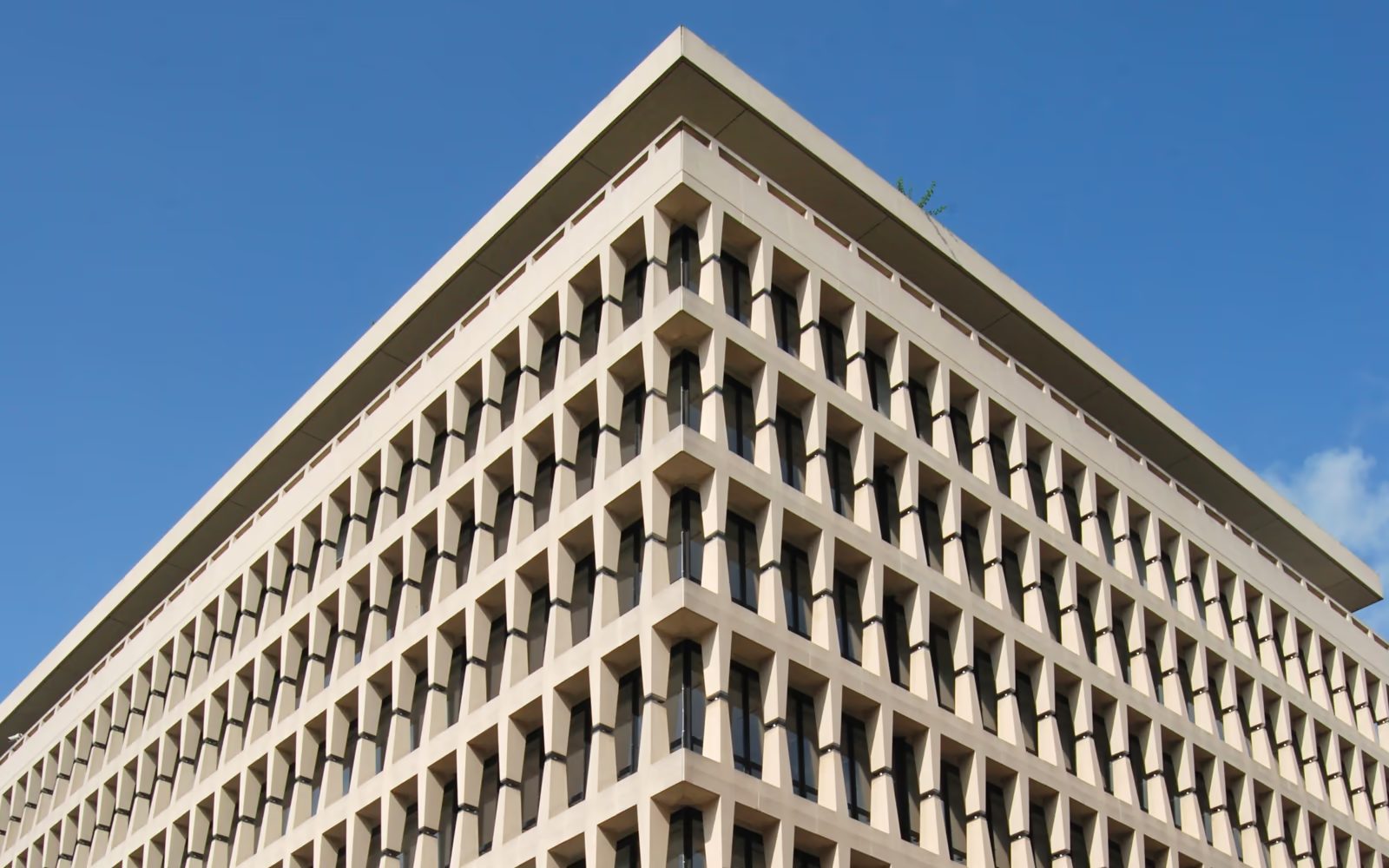
- Photograph of the Banque Lambert headquarters, EmDee, 2017, licence CC BY-SA 4.0