Analysis · Groupe Bruxelles Lambert SA
GBL has never been a passive investor. What is changing is how it exercises power.
Albert Frère carried weight through boardrooms and a handful of large holdings. Ian Gallienne launched the portfolio rotation and built the private-assets capability. Johannes Huth, a KKR veteran, pushes the logic one notch further: control. Forty-four years of capital allocation told through those who ran it.
There is a very simple way to misread GBL: look at its portfolio on two dates, note that the holdings are no longer the same, and conclude that the company has changed its DNA. The history tells something subtler.
Albert Frère's GBL held large listed stakes. The GBL of 2026 buys more private companies. The first often used significant minorities; the second increasingly seeks control or joint control. Behind those differences, however, one idea runs across the eras: GBL has never wanted to be a mere owner of securities.
The central question has always been the power attached to capital. How much must you own to count? Where must you sit to influence a decision? When should a historic stake be sold? And, above all, where should the next euro go?
- 1982Pargesa enters GBLAlbert Frère enters the holding company's capital and becomes its managing director. He had founded Pargesa in Geneva the year before, with the Desmarais family and their partners.
- 1987Albert Frère becomes chairman of the boardHe will hold the chairmanship and the chief executive role together until the functions are separated in 2012.
- 1990The Frère and Power partnership is formalisedThe shareholders' agreement between the two groups still forms the backbone of GBL's control today. Paul Desmarais Jr. joins the board the same year.
- 2012Official start of the portfolio rebalancingIan Gallienne and Gérard Lamarche become managing directors alongside Albert Frère. The chairmanship is separated from the chief executive role.
- 2015Albert Frère leaves the board and the executiveHe asks the 28 April meeting not to renew his term. GBL states that the transition had been prepared as early as 2012.
- 2019Ian Gallienne takes sole operational chargeThe same year, GBL invests EUR 0.9bn to hold 64.7% of the vehicle acquiring Webhelp. Direct private investment changes scale.
- 2022Affidea and SanoptisTwo majority healthcare acquisitions, for EUR 1,000m and EUR 728m of equity, closed in July. Controlled private assets settle at the core of the portfolio.
- 2024Strategic Update of 7 NovemberA sharper roadmap: increase the share of direct private assets, grow net asset value per share, and target a double-digit annual shareholder return over 2024-2027.
- 2025Johannes Huth becomes managing directorAnnounced on 13 March, effective at the 2 May meeting. Ian Gallienne becomes chairman after fourteen years of executive duties.
- 2026Rayner, BUKO, RecordatiControl or joint control becomes the visible signature of newly deployed capital.
1982: Albert Frère does not merely buy a holding company, he changes scale
To understand GBL's DNA, you have to go back before GBL.
Albert Frère comes from the Walloon industrial world. After the Second World War he grew the family business around trading steel products, then acquired companies in the Charleroi basin.
The turning point comes in the early 1980s. In 1981, Frère founds Pargesa in Geneva with his partners, including the Desmarais family. The following year, Pargesa enters the capital of Groupe Bruxelles Lambert. Albert Frère becomes managing director of GBL in 1982, then chairman of the board in 1987.
That move from steel to a holding company is not merely a diversification of family wealth. It is the moment an industrial skill, buying, negotiating, merging, selling, becomes a method of capital allocation on a European scale.
The Frère model: shaping the outcome without necessarily holding 51%
It is tempting to look at GBL's former holdings, Total, GDF Suez, Lafarge, Pernod Ricard, and treat them as a portfolio of listed minorities. Legally, that is often true. Economically, it is incomplete.
Albert Frère had grasped what family holdings know well: the percentage of capital is only one measure of power. The quality of alliances, the stability of the shareholder base, board presence, weight in committees and the ability to be a partner in a strategic transaction can give influence far above the percentage held.
GBL wrote it itself in its 2012 annual report, at the end of the Frère era. Its governance criteria are listed there: hold a main shareholder position, first or second largest; contribute actively to value creation in close collaboration with management; play an active role in the governance bodies, board and committees; and participate in strategic decision-making, in management appointments and compensation, and in the adequacy of the financial structure.
The 2012 report uses a phrase that sums it up: GBL invests in companies where its position and influence will be significant enough to let it play its role of professional shareholder. Not a fund buying a share because it looks cheap: a shareholder seeking a position large enough for its voice to count.
Several major deals of the Frère era follow this consolidation logic. Petrofina is combined with Total. The group takes part in the Suez story and in the consolidation leading to GDF Suez. Lafarge merges with Holcim. Repeatedly, GBL in effect trades a strong position in one company for a smaller position in a larger whole.
The method has an advantage: staying at the heart of major decisions without tying up a majority of the capital. It also has a limit: once the consolidation is done, GBL can end up with a smaller stake, in a bigger group, where its relative influence declines.
What has barely moved: the patient capital behind the active capital
The stability of the shareholder base is the quietest thread in the whole story, and the sturdiest.
The partnership between the Frère group and Power Corporation of Canada dates back to the early 1980s. Since 1990 the two groups have been bound by a shareholders' agreement, extended in December 2012 until 2029, with the possibility of a further extension. In 2026 they still jointly control Pargesa, itself GBL's controlling shareholder.
Frère and Power Corporation
Two family groups bound by a shareholders' agreement since 1990, extended to 2029. They jointly control Pargesa.
Pargesa in GBL
And 48.6% of voting rights at 30 June 2026. The gap between the two measures is not cosmetic: at GBL, capital and voting rights are two distinct pieces of information.
That gap between capital and voting rights deserves a reading of its own, and we have made it elsewhere: see the transparency notification of 26 August 2026, where the concert declares 60% of voting rights without holding 60% of the capital.
This stability is more than a governance detail. It gives GBL something a classic private equity fund does not have: capital with no imposed liquidation date.
It also has a counterpart. It obliges minority shareholders to attach great importance to governance quality, since control cannot be put back in play as easily as in a company with dispersed ownership.
2012: the transition begins before Albert Frère leaves
The second misreading would be to date the transformation to 2015, when Albert Frère leaves the board.
In fact, GBL itself places the start of its portfolio rebalancing in 2012. That year, Ian Gallienne and Gérard Lamarche become managing directors and join Albert Frère on the executive. The chairmanship is separated from the chief executive role.
The press release of 2 February 2015 says so plainly, under the pen of Paul Desmarais Jr., then vice-chairman of the board.
This transition has already been prepared in 2012, with the appointment of Ian Gallienne and Gérard Lamarche as Managing Directors. They will continue to assume together the daily management of the company.
Albert Frère asks the ordinary general meeting of 28 April 2015 not to renew his term as director and to release him from his executive functions after that meeting. The strategic transition and the human transition had therefore begun together, three years earlier.
The disposals of Total and GDF Suez progressively fund new lines. SGS enters the portfolio. Umicore becomes a significant holding. Later come adidas and Ontex. The aim is not yet to become mostly private: it is to move GBL away from a portfolio concentrated in energy and utilities, heavily dependent on dividends, and to build more growth.
The scale of that first transformation is large. In 2019, GBL writes that the portfolio rotation begun in 2012 totals EUR 19 billion of disposals and acquisitions, and that it produced a substantial shift from high-yielding cyclical assets in energy and utilities into growth assets in consumer goods, industry and business services.
Ian Gallienne: private equity was already in the house
Ian Gallienne's record matters for understanding the next period.
Before GBL, Gallienne ran private equity funds at Rhône Capital, in New York and London, from 1998 to 2005. He then founded Ergon Capital Partners in Brussels and remained its managing director until 2012. He has sat on GBL's board since 2009, became managing director in January 2012, and took sole operational charge after the April 2019 general meeting.
In other words: private equity expertise does not arrive at GBL with Johannes Huth. It has been in the executive for more than a decade.
The real break in 2019 lies elsewhere. GBL starts using that expertise directly on its own balance sheet.
Webhelp
GBL holds 64.7% of the acquisition vehicle, on an enterprise value of EUR 2.4bn. For the first time at this scale, GBL is not merely a reference shareholder: it controls and consolidates.
Affidea
Majority acquisition in medical imaging, closed in July. Controlled private assets reach a size that weighs on the accounts.
Sanoptis
Majority acquisition in ophthalmology services, also closed in July, with management reinvesting alongside GBL.
In that same year 2019, Parques Reunidos is taken private alongside EQT and Alba. Then come Canyon and Voodoo.
The middle period matters, because it was not linear
A history written after the fact often makes everything look obvious: Frère builds, Gallienne prepares the private turn, Huth finishes the job.
The reality is richer.
Between 2012 and 2024, GBL does not merely add private companies. It builds several investment layers. Sienna Capital, later GBL Capital, develops funds, co-investments, private equity, private debt and venture. From 2021, Sienna Investment Managers is built as a third-party asset management platform, with activities in real estate, traditional management, private credit, private equity and venture.
As late as 2023, GBL presents four distinct categories: listed assets, private assets, GBL Capital and Sienna Investment Managers. The model is more diversified, but also more complex. A shareholder has to understand a holding company that owns listed companies, controls private ones, invests in funds and builds an asset manager alongside.
That complexity helps explain the Strategic Update of November 2024. The problem to solve is no longer only finding new investments. It is deciding which GBL the group wants to be.
Johannes Huth: twenty-five years at KKR to execute the next phase
On 13 March 2025, GBL announces a new governance. Paul Desmarais Jr., on the board since 1990 and chairman since 2019, asks to step down from the chairmanship at the close of the 2 May meeting and remains vice-chairman. Ian Gallienne becomes chairman of the board, ending fourteen years of executive duties. Johannes Huth is proposed as a director and takes executive responsibility as managing director.
Huth's profile is very different from that of a listed portfolio manager. He joins GBL after twenty-five years at KKR, where he was a partner and chairman of the group's operations for Europe, the Middle East and Africa. Before KKR, he was a member of Investcorp's management from January 1991 to January 1999. From June 1986 to January 1991, he worked at Salomon Brothers as a vice-president in the mergers and acquisitions departments in London and New York.
For most of his career his trade has therefore been to buy companies, structure transactions, work with their executives and boards, raise capital and prepare exits.
The crucial point is that GBL does not present his arrival as a reset. The release explains that his appointment is consistent with the strategy announced at the Strategic Update of 7 November 2024. Huth is hired to execute a direction decided before he arrived.
the perimeter
Reduce the less strategic layers and free up capital. This is the gradual exit from activities the company no longer considers core.
into direct private assets
More assets where GBL controls or jointly controls the trajectory, rather than listed minority positions.
capital
A sustainable dividend and share buybacks, as the second leg of value creation per share. The stated target is a double-digit annual shareholder return over 2024-2027.
Rayner, BUKO and Recordati let us watch that record turn into a portfolio. In each case the investment is not designed as a mere financial line: governance is part of what is bought.
joint control with CVC
Around 45% economic interest. Transaction closed on 28 May 2026.
control
Around 95% of the capital, with BUKO's management reinvesting alongside GBL. Closed on 8 July 2026.
joint control, tender offer
Alongside CVC Capital Partners Fund IX. Announced on 22 May 2026, closing expected in the fourth quarter. The ticket is a maximum, not a committed amount.
Does Huth break with Albert Frère? Yes and no
Yes, if you look at the instruments.
Albert Frère built his influence through significant minority stakes in large listed groups, alliances and board seats. Huth favours private transactions, contractual control and platforms whose acquisitions and strategy GBL can steer directly.
No, if you look at the philosophy.
In both cases, a holding is only worth having if it gives GBL something beyond stock market exposure. Under Frère, that something was strategic influence. Under Huth, it more often becomes control.
GBL's history can be read as a steady increase in the price paid for power. Yesterday, a minority large enough to count. Today, more capital in order to decide.
That comparison also explains why private equity is natural ground for GBL. A listed holding with permanent capital can keep a company longer than a closed-end fund, finance several acquisition cycles and choose the moment of its exit. It can also use its own shares and balance sheet to arbitrate between acquisitions, dividends and buybacks.
Albert Frère
Large minority stakes and a board seat. Concentrated European holdings, family alliances, a role in the great industrial consolidations.
Ian Gallienne
Portfolio rotation and the building of new capabilities. Diversification of the listed book, development of alternatives, the start of direct private investment, then majority acquisitions.
Johannes Huth
Simplify and control. Fewer non-core layers, larger tickets, control or joint control, and an explicit return of capital to shareholders.
This synthesis simplifies mandates that overlap in time. Gallienne is a managing director from 2012, alongside Frère, and Huth executes a roadmap set before his arrival. It serves to visualise the dominant logic of each phase, not to settle dates.
Why people matter more at GBL than at a conventional company
At an industrial company, an investor can analyse the plants, the brands, the customers, the margins and the market shares. Management matters enormously, but the asset exists independently of it.
At an investment company, capital allocation is the product.
A euro of cash can become an SGS share, an acquisition of BUKO, a stake in Recordati, a GBL buyback or a dividend. Future value therefore depends directly on the person and the governance system arbitrating between those possibilities.
That is why the Gallienne to Huth transition deserves more attention than a conventional change of chief executive. Johannes Huth does not merely inherit an operating organisation: he inherits the right to decide where several billion euros will gradually be redeployed. For scale, GBL reported net asset value of EUR 15.7 billion at the end of December 2024.
And that confidence has a very concrete market translation: the discount.
An investment company rarely trades exactly at the sum of its assets. The gap reflects tax, costs, liquidity and complexity, but also something far less mechanical: what the market thinks management will do with the next euro.
When investors trust the allocator, they may accept a narrower discount. When they fear complexity, poor acquisitions or structure costs, the discount can widen. The manager therefore becomes a component of the holding company's value.
The new GBL does not erase Albert Frère. It translates his DNA into another language.
It would be tempting to end this history with a simple opposition. Frère, the man of large listed groups. Gallienne, the man of the transition. Huth, the man of private equity.
That reading is convenient. It is too simple.
Frère built a system in which a holding had to give access to the decision. Gallienne kept that engaged-shareholder culture while rotating the portfolio, diversifying the growth engines and building private equity capability. Huth receives a more concentrated mandate: simplify what has accumulated, and use GBL's permanent capital to buy control itself more often.
The common thread is therefore neither the stock market nor private equity. It is the conviction that a holding company must be more than a portfolio. It must know why it owns a company, what power that ownership gives it, what it can do with that power, and when it is better to sell.
Frère bought influence. Gallienne widened the toolkit. Huth buys more control. In all three cases GBL remains a machine whose trade is to turn capital into shareholder power, and then that power into value per share.
The phase beginning in 2025 and 2026 will therefore be judged on a fairly old criterion: neither the number of transactions completed, nor even the proportion of private assets in the portfolio, but the value created after obtaining more power over the companies held.
The next reading has a date. GBL will publish its 2026 full-year results in March 2027. It will be the first time Johannes Huth's mandate can be read over a full financial year rather than through announcements. The Groupe Bruxelles Lambert profile tracks those meters.
Sources
- GBL, 2012 annual report: governance criteria, professional shareholder and eighteen board seats
- GBL, press release of 2 February 2015: non-renewal of Albert Frère's term as director
- GBL, 2019 annual report: EUR 19 billion of rotation since 2012 and the Webhelp acquisition
- GBL, press release of 13 March 2025: new governance and Johannes Huth's record
- GBL, Strategic Update of 7 November 2024
- GBL, shareholding at 30 June 2026 and the Frère and Power agreement extended to 2029
- GBL, 2023 annual report: the four-category portfolio architecture
- GBL, 2026 half-year report: Rayner, BUKO and Recordati
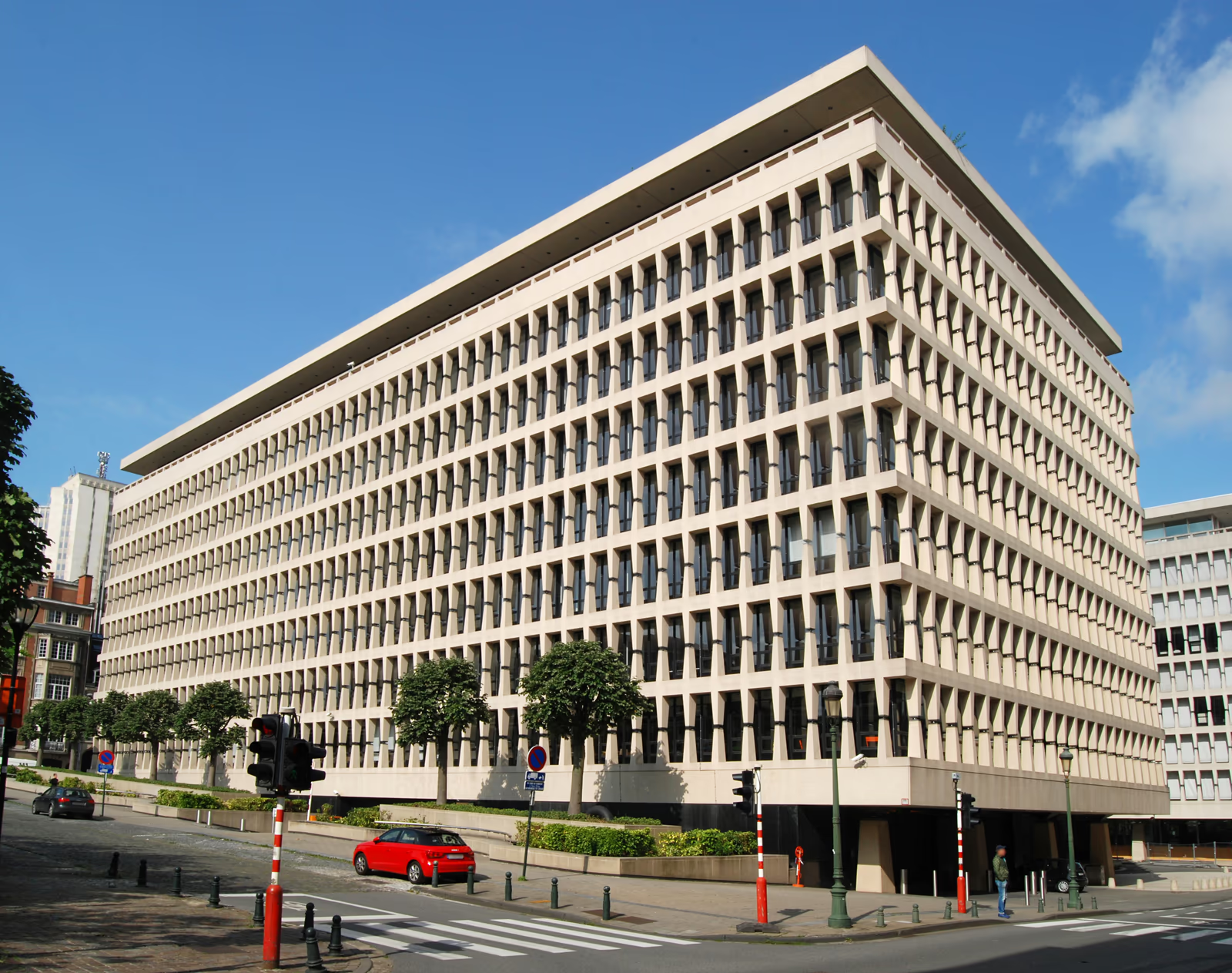
- Photograph of the Banque Lambert headquarters, EmDee, 2017, licence CC BY-SA 4.0