News · Exor N.V.
Exor and Stellantis: Ram recovers, Jeep declines, cash must confirm the turnaround
Second-quarter profits improve while third-quarter US sales stagnate. Repair at the manufacturer has not yet restored distributions to Exor.
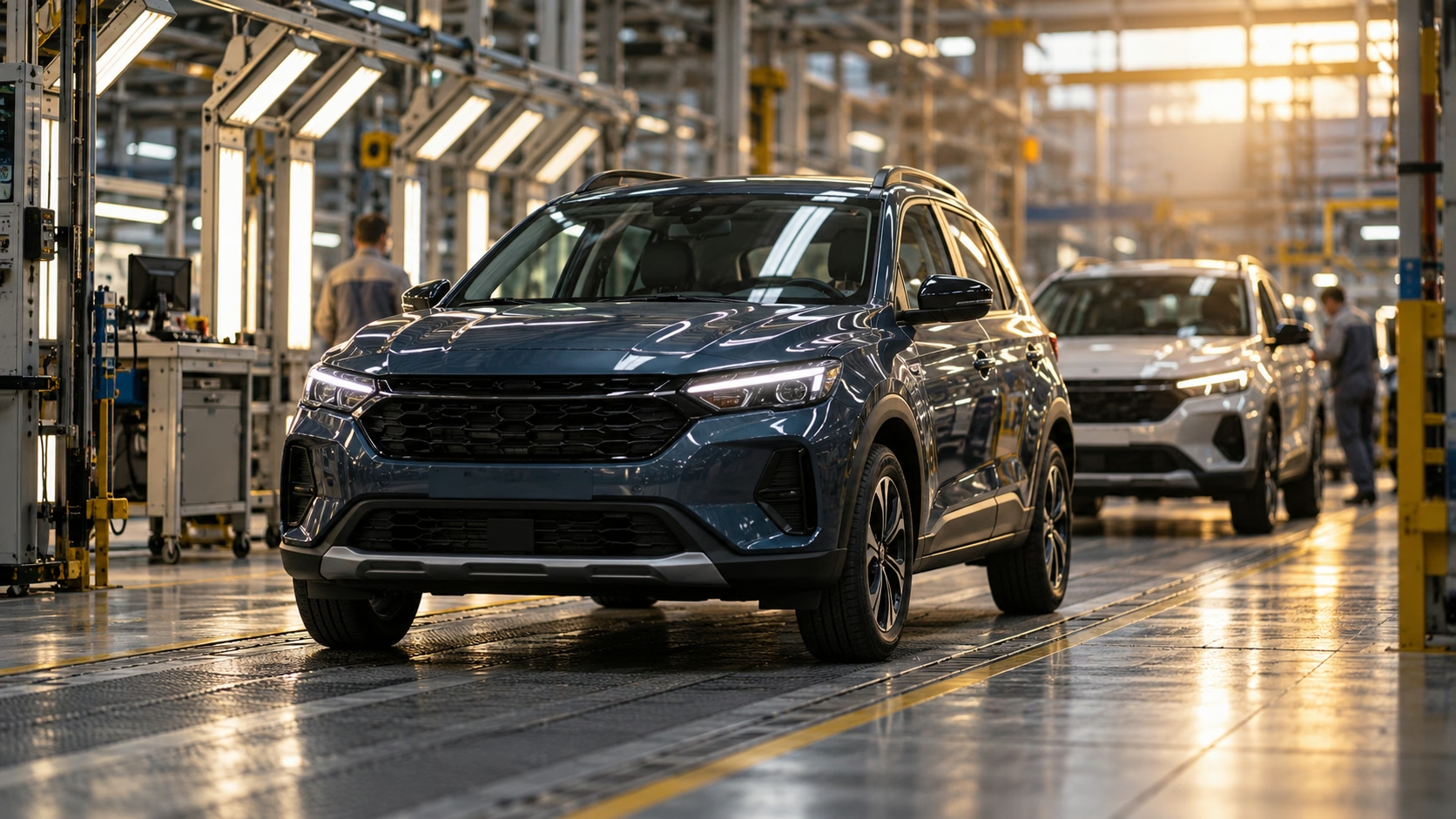
Stellantis sold 324,277 vehicles in the United States in the third quarter, against 324,825 a year earlier. The total is almost unchanged. Behind the number published on 1 October, two brands tell opposing stories: Ram grew 29%, while Jeep declined 20%.
For Exor, a reference shareholder in the manufacturer, the question goes beyond cars sold. Recovery must pass through sales, margin, industrial cash generation and eventually money distributed to shareholders. Profits and industrial cash did improve in the second quarter. Third-quarter US sales alone cannot confirm that this improvement continued.
Do the documents point to continuing deterioration or recovery? They show real but incomplete repair, with offsetting engines and still thin profitability. That mechanism needs examination without selecting the conclusion in advance.
Why Stellantis still matters to Exor
Exor is the Agnelli family’s listed investment company. Its holdings include Ferrari, Philips, CNH and Stellantis. The manufacturer brings together brands including Peugeot, Fiat, Jeep and Ram. Exor owns 15.5% of Stellantis’ economic rights, according to its interim report: a minority interest held by a reference shareholder, rather than direct ownership of every factory or its cash.
At 30 June, Exor values this stake at €2.236 billion, against €4.252 billion at the end of 2025. It represents 6.3% of gross assets, before subtracting holding-company debt and other liabilities. Our analysis of Exor’s first half already explained the €2.016 billion decline in value. The new question is whether the manufacturer’s economics are beginning to repair the damage to this investment.
The stake’s valuation can move with Stellantis’ share price. Cash received by Exor depends on distributions or potential monetisation. An improvement on the factory floor does not automatically reach that second stage.
Ram offsets Jeep without lifting the total
The US release distinguishes total sales from retail sales. Promotional percentages for individual models therefore do not always use the same perimeter. To compare brands, we use total sales from the official table.
| Total US sales | Q3 2025 | Q3 2026 | Change in vehicles |
|---|---|---|---|
| Ram | 103,717 | 134,072 | +30,355 |
| Jeep | 160,564 | 128,542 | −32,022 |
| Other brands, Opulion calculation | 60,544 | 61,663 | +1,119 |
| Stellantis, total | 324,825 | 324,277 | −548 |
Opulion calculation: each change is the difference between the columns. Other brands equal the total less Ram and Jeep. The three contributions reconcile exactly to the decline of 548 vehicles.
Ram benefits notably from its light-duty pickup, with 76,650 units against 44,349. At Jeep, the returning Cherokee hybrid does not offset declines elsewhere: Grand Cherokee falls 30% and Compass 62%. The new product is growing within a shrinking brand total.
For the first nine months, US sales remain up 3% in the company’s presentation. The third quarter is therefore less dynamic than the cumulative period. This slowdown is worth examining, but describes neither every region nor the margin on each vehicle. An additional pickup and one fewer SUV need not contribute equally to profit.
Second-quarter accounts already showed improvement
Worldwide, Stellantis reported €43.482 billion of second-quarter revenue, up 13%. Adjusted operating income increased from €213 million to €773 million, and margin from 0.6% to 1.8%. Net income became positive at €293 million, after a €1.869 billion loss in the comparable quarter.
These figures establish an economic improvement. They also show a limited cushion: €1.80 of adjusted operating income per €100 of revenue. Prices, product mix, costs, recalls and tariffs can still materially affect that balance.
North America returned to positive adjusted operating income of €284 million and a 1.6% margin. Enlarged Europe remained at −€94 million and −0.6%. Describing a uniform recovery would hide that difference.
The report also attributes part of the increase in North American shipments to inventory building before planned summer production shutdowns. Shipments to the network grew 37.8% in the second quarter. These are not third-quarter US sales to final customers. The periods, territories and commercial stages differ.
North America’s profit bridge shows a €409 million volume-and-mix effect but a −€59 million net vehicle pricing effect. Industrial performance contributes €603 million, with reduced regulatory expenses among the factors cited in the commentary. Recovery therefore does not yet establish a broad improvement in pricing power.
Cash recovered in the quarter, but remains negative for the half
Industrial free cash flow reached +€1 billion in the second quarter, against +€31 million a year earlier. For the first half, however, it remained −€921 million, against −€3.005 billion in 2025.
By subtraction, the first quarter of 2026 absorbed approximately €1.921 billion: the half-year’s −€921 million less the second quarter’s positive €1 billion. This is an Opulion calculation using the same indicator. It demonstrates sequential improvement; it does not justify extrapolating €2 billion of positive cash into the second half.
Industrial free cash flow is an adjusted measure defined by Stellantis. It differs from consolidated operating cash flow, which was −€2.887 billion for the half. Different perimeters, investment spending and adjustments mean these measures cannot be substituted for one another.
The quality of this improvement also needs examination. The report attributes a favourable €2.070 billion contribution to the decrease in the item combining capital expenditure, capitalised R&D and changes in related payables, against a €447 million improvement in industrial operating cash flows. Better cash therefore does not come solely from higher current earnings. Investment and payment timing also matter; the figures cannot attribute the entire gap to a lasting reduction in requirements.
The report also explains working capital. The manufacturer generally receives payment quickly for shipped vehicles and pays suppliers later. When shipments slow, payments for earlier production continue while new receipts decline. Higher volumes can help this cash cycle; its durability still needs observation.
Stellantis retained €44.1 billion of available industrial liquidity at 30 June, including credit facilities. This is neither net cash nor money available to Exor. Management still targeted improved industrial cash flow in 2026 and a return to positive territory in 2027, rather than a 2026 already established as sustainably cash-generative.
- SALESSelling the modelsCheck customer sales, mix and inventories beyond shipments to the network.
- MARGINEarning after costsFollow net prices, discounts, industrial costs and exceptional charges.
- INDUSTRIAL CASHFunding the manufacturerAccount for investment and operating requirements under the published measure.
- DISTRIBUTIONSending liquidity upstreamA distribution decision is still needed before Exor receives cash.
For the holding company, dividends remain missing evidence
Exor received no Stellantis dividend in the first half of 2026, against €306 million a year earlier. Multiplying second-quarter industrial cash flow of €1 billion by 15.5% would produce a theoretical share, not actual holding-company receipts.
Stellantis can retain resources for investment, debt and transformation. During Exor’s 23 September call, an analyst asked about a potential capital increase at the manufacturer. The CFO supported the turnaround plan and said he was unaware of any such plans. That response is neither an announced capital call nor a guarantee about future funding needs.
For Exor, useful scenarios are therefore conditional. If profitable sales stabilise, margins improve and industrial cash becomes sustainably positive, distribution capacity can rebuild. If recovery relies chiefly on inventories and brands offsetting one another, the portfolio may remain exposed to a business consuming capital despite better accounting results.
What the next results need to distinguish
The next financial release must connect third-quarter sales to shipments, inventories, net prices and cash. Has Ram improved mix and margin? Has Jeep’s decline been offset without greater discounts? Is Europe approaching break-even? Does positive second-quarter cash repeat after investment and restructuring payments?
For now, second-quarter results support repair, while third-quarter US figures show it remains uneven. Exor shareholders need to follow both channels: what Stellantis is worth in the portfolio and what it can actually distribute. The manufacturer may start recovering before the holding company regains its former source of cash.
Sources
- Stellantis, third-quarter US sales, release dated 1 October 2026
- Stellantis, second-quarter results, 30 July 2026
- Stellantis, interim report at 30 June 2026, regional results and industrial cash definition
- Exor, 2026 interim report, ownership, stake valuation and dividends
- Exor, transcript of the 23 September 2026 call
Share this article