News · Baillie Gifford US Growth Trust plc · Scottish Mortgage Investment Trust PLC · Sofina SA
Anthropic and Accenture commit at least USD2 billion to testing AI from the inside
An external evaluator will be able to observe model design and deployment. For three listed holdings exposed to Anthropic, the test is whether that access becomes real oversight or merely another compliance cost.
Courtesy translation of the French original.
Anthropic and Accenture each expect to invest at least USD1 billion over five years in a new form of artificial-intelligence evaluation. Specialists led by Faculty will work close to Anthropic's teams, models and selected deployment decisions. The combined USD2 billion is neither an immediate payment to Accenture nor guaranteed new revenue for Anthropic.
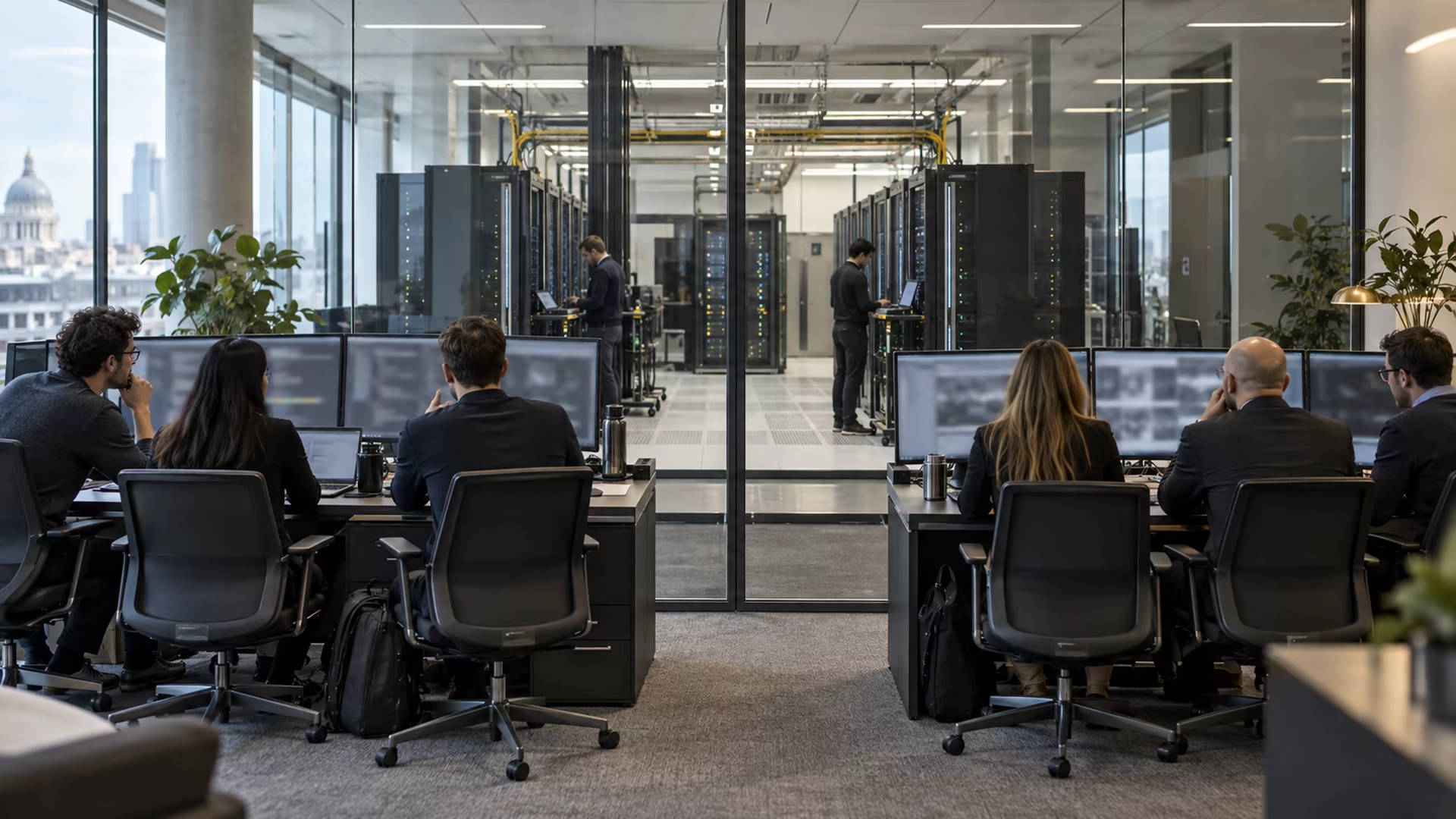
What changes: the evaluator enters the engine room
Conventional audits often arrive after a system has been designed. Anthropic and Accenture want to test another approach. Faculty, Accenture's specialist artificial-intelligence business, will place evaluators alongside the teams that train, test and deploy Anthropic models.
According to Anthropic's 18 September announcement, those specialists may red-team models, assess alignment, examine safeguards and report incidents. The aim is to find risks during development rather than only after release.
Periodic audit
Independence is easier to see, but access may be late and limited.
Embedded evaluation
Better access, but greater proximity to the company being examined.
Incident monitoring
Value depends on reporting rights and transparency of findings.
The useful mental model is not a consultant certifying a machine from outside. It is an independent mandate placed inside the process, with access comparable to selected employees but a different purpose.
USD2 billion, but who pays for what?
Anthropic and Accenture say each will invest at least USD1 billion over five years. The total may include recruitment, teams, tools, infrastructure and commercial work. It does not mean Anthropic will pay USD1 billion to Accenture or that Accenture will invest USD1 billion in Anthropic's equity.
Anthropic is directly funding Accenture's initial involvement. The arrangement is non-exclusive and no permanent shared funding model has been settled. Future disclosures therefore need to separate three flows:
- Anthropic's own spending on safety teams; - fees or services bought from Accenture; - Accenture's investment in building a business that can serve other clients.
Until that split is available, USD2 billion primarily measures the strategic priority assigned to the subject.
Why three investment companies are affected
US Growth: large enough to move net asset value
Baillie Gifford US Growth valued Anthropic at GBP63.46 million, or 6.61% of gross assets, at 31 July. That weight makes it one of the private holdings capable of moving net asset value per share.
Stronger model governance may reduce the risk of an incident, regulatory restriction or loss of trust among enterprise customers. It also creates a certain expense in exchange for a benefit that is difficult to measure.
Scottish Mortgage: more money, but a more diluted weight
Scottish Mortgage reported a value of GBP460.32 million, or 2.76% of assets, on the same date. The sterling amount is much larger than US Growth's, but so is the trust.
The transmission is therefore material without being dominant. The announcement matters mostly to the quality of the underlying company: Anthropic is turning a safety promise into a funded operating function.
Sofina: indirect exposure without an individual value
Sofina ranks Anthropic fourth among its indirect exposures through funds. As with SpaceX, the individual weight is not disclosed. The ten largest indirect investments together represent about 10% of the funds' look-through portfolio.
The economic link exists, but Opulion cannot calculate the effect of this announcement on Sofina's net asset value.
- US Growth GBP63.46m at 31 July 2026
- Rest of US Growth portfolio Other listed and private holdings
The paradox: better access, but who protects independence?
Embedded evaluation addresses a real problem. An outside auditor may miss daily trade-offs, intermediate versions and the reasons behind a deployment decision. An embedded evaluator sees more.
That proximity also creates tension. Anthropic is currently paying Accenture to examine Anthropic. Standards for access, publication and escalation have not yet been settled. Anthropic also states that responsibility for safety remains its own.
The arrangement's value will therefore depend less on its budget than on four concrete rights:
The announcement extends our work on a potential Anthropic flotation and the cost of the frontier-model race. It adds a third dimension: after valuation and financing, the quality of control is becoming an economic factor too.
What shareholders should take away
Fact. Two groups expect to invest at least USD2 billion in total in evaluation and safety over five years.
Opulion calculation. An even spread would be about USD400 million a year. This is not annual guidance because spending may be uneven.
Inference. Anthropic is trying to turn safety into a commercial advantage for businesses and governments that hesitate to entrust critical processes to artificial-intelligence models.
Unknowns. The evaluator's exact rights, incident publication, spending split and effectiveness measures have not been defined.
For shareholders in the three holdings, the test is straightforward: will the programme genuinely reduce the risk attached to an important private investment, or mainly add cost and communications? Future incidents and the transparency of the arrangement, not the announced amount alone, will supply the answer.
Sources
- Anthropic, Accenture and Anthropic announce embedded evaluation partnership, published 18 September 2026
- Baillie Gifford US Growth Trust, portfolio and net asset value at 31 July 2026
- Scottish Mortgage Investment Trust, portfolio published at 31 July 2026
- Sofina, 2026 half-year results presentation, indirect exposures at 30 June 2026
Sources
- Accenture and Anthropic announce embedded evaluation partnership · Anthropic · Sep 18, 2026
- Baillie Gifford US Growth Trust portfolio · Baillie Gifford · Jul 31, 2026
- Sofina 2026 half-year results presentation · Sofina · Sep 3, 2026
- Scottish Mortgage portfolio · Scottish Mortgage · Jul 31, 2026
Share this piece