News · Wendel SE
Wendel: Stahl becomes €1.14 billion of cash to reallocate
Closing confirms value already recorded. The next use of capital must replace the asset sold and the earnings it supplied.
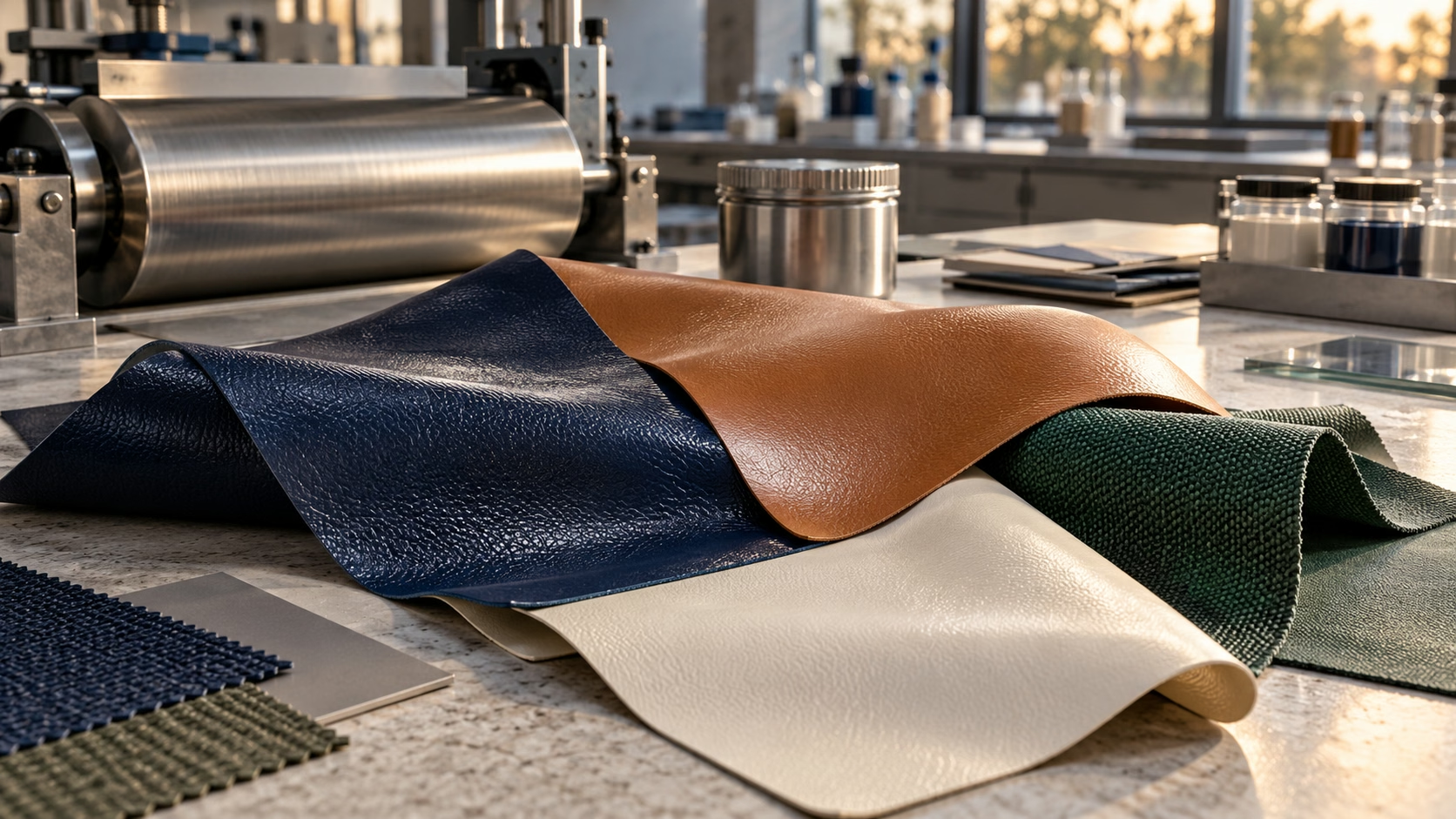
On 1 October, Wendel completed the sale of its stake in Stahl to Henkel following regulatory approvals. It receives €1.14 billion net of debt and fees. The announced enterprise value is €2.1 billion: that second figure describes a different perimeter and is not Wendel’s receipt.
After twenty years, an industrial investment becomes a resource the holding company can reallocate. This is the new development. The transaction was already used to value Stahl in June’s net asset value. Closing confirms liquidity and execution; it does not create a second uplift equal to the sale proceeds.
For shareholders, the question is precise: what must the next use of this €1.14 billion produce to replace the value and earnings of the asset sold?
What actually leaves the portfolio
Wendel invests its own balance sheet in companies and also owns fund managers. Stahl belonged to the former business, Wendel Principal Investments. The unlisted company produces specialty coatings that give materials surface properties, notably for leather and textiles.
The sale to Henkel excludes Muno, which remains in the portfolio. Reading it as the disappearance of Stahl’s entire historical industrial perimeter would ignore that separation. Equally, after completion, Wendel no longer retains the same economic exposure to the businesses sold.
The €2.1 billion enterprise value describes the sold business before moving to shareholders’ interests. Net proceeds of €1.14 billion describe what accrues to Wendel after the announced debt and fees. The difference is not a €960 million loss for the holding company: the figures concern different rights and deductions. The release supplies no detailed bridge allocating the entire gap to one item.
Cash confirms a value already recorded
Wendel compares the proceeds with a €960 million valuation at 30 September 2025, before the transaction announcement. The increase is €180 million, or 18.75%, rounded to approximately 20% in the release. Opulion calculation: 1,140 / 960 − 1.
This is a historical comparison. The net asset value table at 30 June 2026 explicitly states that Stahl is valued at the transaction price. Applying another 20% uplift to that June value because cash has now arrived would count the same revaluation twice.
- 30 SEPTEMBER 2025Pre-announcement referenceWendel cites €960m as the comparison for the price achieved.
- 30 JUNE 2026Transaction price already usedNAV values Stahl on this basis before receipt of the proceeds.
- 1 OCTOBER 2026Sale completedWendel receives €1.14bn net; transaction execution risk is removed.
The distinction between value and liquidity changes the balance-sheet reading. Before closing, the holding company owns a stake whose sale remains to be completed. Afterwards, it owns cash arising from that stake. The money can be reinvested or used for other obligations; the sold company no longer supplies its former exposure to future earnings.
This does not mean each euro received increases total wealth by one euro. An asset leaves in exchange. Final accounting profit, taxes and other adjustments must be read in the corresponding accounts; the release does not provide a complete post-transaction NAV.
Twenty years of returns cannot be reduced to one multiple
Wendel reports a 6.3-times net multiple and an internal rate of return above 15% since the 2006 investment. The multiple includes €427 million of historical distributions.
These distributions are not additional cash arriving for a second time in October. They were received during ownership. Adding €1.14 billion and €427 million offers a cumulative reference for announced proceeds, but not new closing cash or a complete reconstruction of net returns without detailed flows.
Internal rate of return incorporates the timing of contributions and distributions. A cumulative multiple does not. Receiving part of the return years before an exit has a different financial effect from receiving everything after twenty years. The two measures therefore cannot be directly converted into one another.
The stake also supplied current earnings: Stahl contributed €46.2 million to WPI’s net income from operations in the first half of 2026, before allocation to minority interests. This is neither a dividend paid to Wendel nor guaranteed annual income. It nevertheless reminds us that a sale removes a profit engine while releasing capital.
Reallocation connects two different businesses
Our article on Wendel’s hybrid model explained the development of Wendel Investment Managers, or WIM. IK Partners, Monroe Capital and Committed Advisors manage client capital. Wendel owns the managers and also invests in some of their funds.
At 30 June, WIM reported €48.7 billion of assets under management and €87.1 million of fee-related earnings, or FRE, for the half. Group-share FRE was €51.1 million. The €48.7 billion belongs to the management perimeter; it does not become €48.7 billion of Wendel’s own assets. Nor is FRE a dividend automatically received by the parent.
The Stahl sale can fund several uses. The release mentions the acquisition of Committed Advisors and more than €500 million returned to shareholders in 2026, including completed buybacks. It does not, however, allocate the €1.14 billion received in October to a detailed future programme.
Buying a company
Returns depend on earnings, distributions and exit prices; the sold asset’s income needs replacing.
Developing WIM
Assess price paid, fundraising, margin, minority interests and distributable cash.
Retaining or returning resources
Debt, fund commitments, buybacks and dividends draw on the same financial capacity.
The transformation’s real test is therefore not headline managed assets. It is the return on Wendel’s capital after acquisition prices, costs and other investors’ rights. Recurring fees can improve business visibility; buying the manager can also absorb substantial capital and create deferred payments.
October cash cannot be pasted onto June’s balance sheet
Wendel reported €507 million of cash and financial assets at 30 June, before the disposals. Mechanically adding €1.14 billion to that amount would produce theoretical cash that ignores intervening acquisitions, repayments, distributions and commitments.
Wendel’s commitments to WIM funds totalled €776 million at 30 June, including €273 million already deployed. The balance need not be called immediately, but shows that some future resources already have a contractual destination. It must be distinguished from investments the holding company could freely choose tomorrow.
The release scheduled for 22 October concerns a balance sheet dated 30 September. The Stahl closing on 1 October is therefore subsequent to it. Readers need to examine subsequent events and any pro forma data without backdating cash receipts. Pro forma information is useful when it specifies the transactions included; it does not replace actual closing cash.
Our interpretation is that Wendel has converted negotiated value into capacity to act. The next stage is more demanding: documenting uses of the proceeds and returns on newly committed capital. Stahl’s success provides a track record; it does not guarantee that the next use of resources will reproduce it.
Sources
Share this article