News · Prosus N.V.
Prosus: Tencent, 70.8% of its assets, swings from RMB58.2bn of net cash to RMB13.7bn of net debt
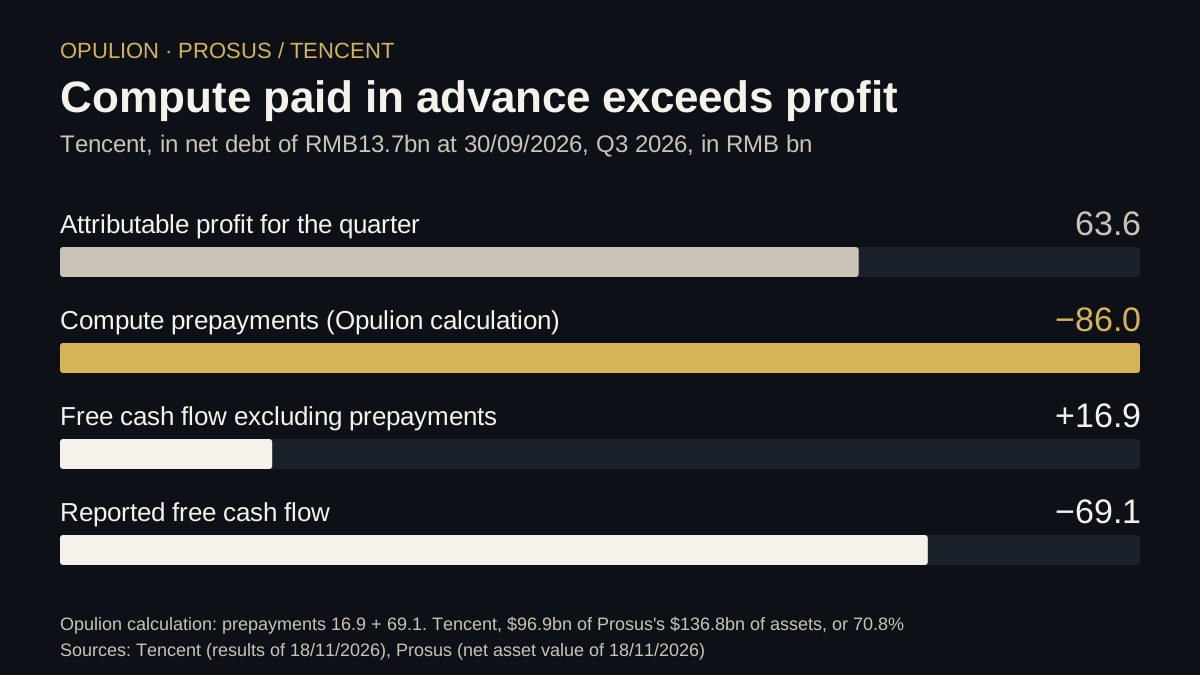
In the third quarter of 2026, Tencent's attributable profit was RMB63.6bn, 0.8% more than a year earlier, but its free cash flow was −RMB69.1bn and Tencent moved from RMB58.2bn of net cash to RMB13.7bn of net debt. According to Tencent, this was primarily due to large compute procurement. Tencent makes up 70.8% of the assets Prosus published for 18 November.
Why it matters for Prosus shareholders: Prosus holds 2,040.9 million Tencent shares as at 13 November, carried at $96.9bn at a price of HKD372.8 in the net asset value it published for 18 November. Tencent pays it an annual dividend: HKD5.30 per share for 2025, paid in 2026, and no interim dividend for the first nine months, as in 2025. The holding that makes up 70.8% of Prosus's assets increased its borrowings by RMB81.2bn in one quarter (RMB380.1bn at 30 September against RMB298.9bn at 30 June, Opulion calculation), a quarter in which it moved into net debt, primarily due to large compute procurement according to Tencent.
The cash flow reconciles: RMB2.6bn of operating cash flow, minus RMB65.1bn of capital expenditure payments, RMB4.6bn of media content payments and RMB2.0bn of lease payments, gives −RMB69.1bn (Opulion calculation). According to Tencent, operating cash flow included significant prepayments for compute procurement to support enhancements to its Hy model family, WorkBuddy inference needs and the development of AI capabilities across its products and services, as well as to meet external demand for its cloud services. Tencent does not publish their amount. It gives the free cash flow it would have recorded without them, a positive RMB16.9bn: the difference, RMB86.0bn (16.9 + 69.1, Opulion calculation), exceeds the quarter's attributable profit.
The income statement shows the same tension. Revenues rose 8% to RMB207.3bn. Non-IFRS operating profit, Tencent's adjusted measure, fell 6% to RMB68.1bn, but rose 8% to RMB83.3bn excluding the contributions of new AI products (primarily Hy, Yuanbao, CodeBuddy, WorkBuddy and Xiaowei, according to the announcement). The difference, RMB15.2bn in Q3 (83.3 − 68.1, Opulion calculation), is what these products took off non-IFRS operating profit. Prosus updates the number of Tencent shares it counts, and its own shares in issue, as of 13 November, in line with the buyback programme that our brief of 12 November followed week by week: €101.8m bought back in the week of 2 November, the largest of the six.
Q3 attributable profit
0.8% more than a year earlier, while non-IFRS profit attributable fell 6% to RMB66.5bn.
Q3 buybacks
15,867,600 shares bought back from July to September, then cancelled.
Amount of the prepayments
Tencent publishes free cash flow with and without them, not their amount.
For Prosus shareholders, three publications will matter. On 25 November, according to Prosus's calendar, its half-year results, its first accounts since this Tencent quarter. Then Tencent's free cash flow in the fourth quarter, which would show whether these prepayments recur. The third will take longer: the dividend Tencent would propose for 2026, what the holding would pay Prosus in cash after a year of investment.
Sources
- Tencent, announcement of the results for the three and nine months ended 30 September 2026, 18 November 2026 · Tencent Holdings Limited · Nov 18, 2026
- Prosus, net asset value of 18 November 2026
- Prosus, events calendar (half-year results on 25 November 2026) · Prosus N.V. · Nov 12, 2026
Share this article