Analysis · Investment AB Latour
In India, Swegon adds 600 MW of substance to Latour's industrial strategy
The order does not yet quantify its contribution to profits. However, it demonstrates how Latour is opening a potential revenue stream from equipment, and subsequently from recurring services, within an asset it fully controls.
Courtesy translation of the French original.
The essentials
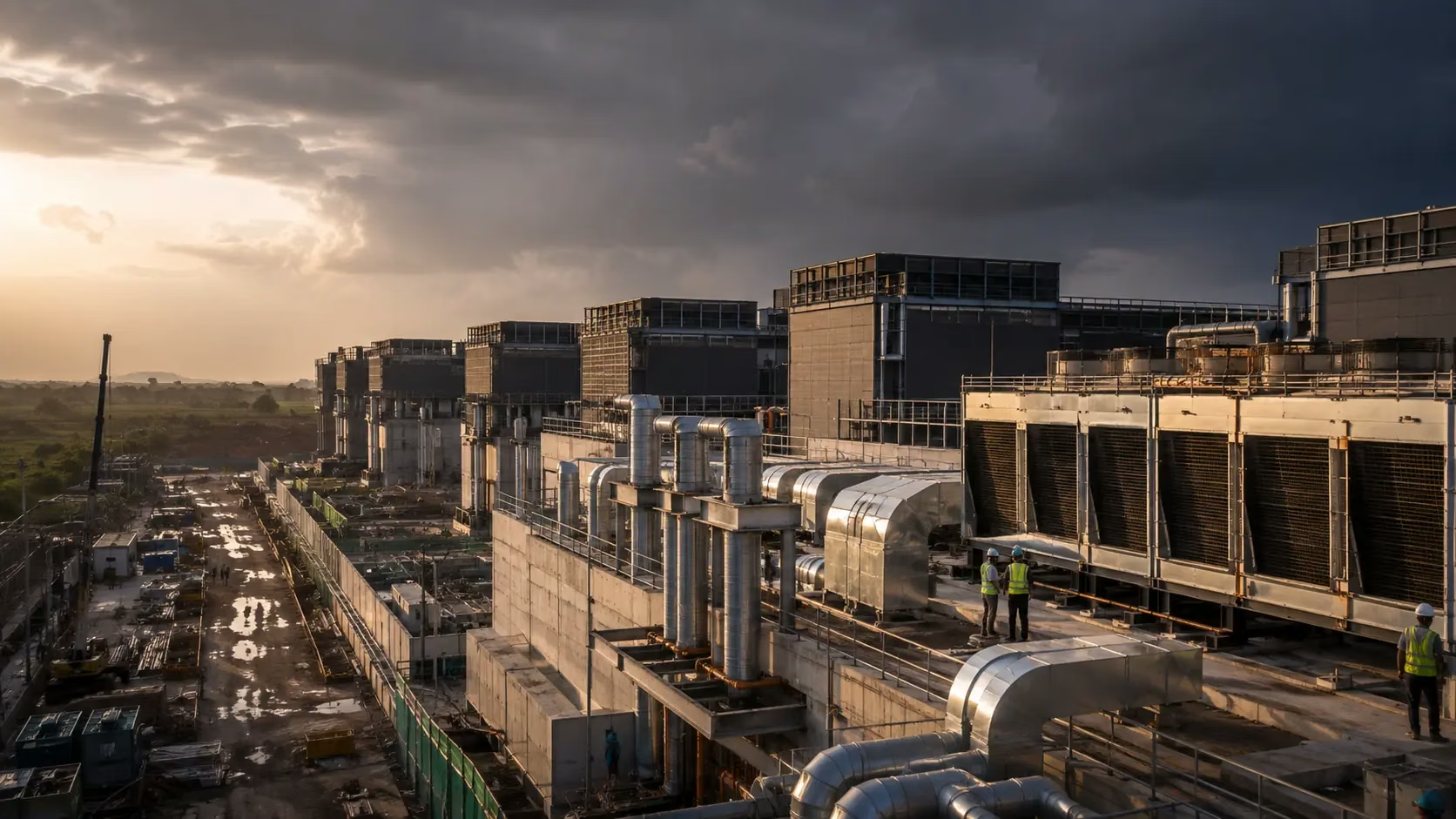
Swegon will provide the complete cooling and air handling solution for a large data center campus in Hyderabad. The site will comprise six buildings, each housing two data centers, for a combined announced capacity of 600 MW. The contract includes installation, commissioning, and five years of maintenance. For Latour's shareholder, the interest lies less in the spectacular capacity figure, which is not the value of the order, than in the demonstration of a model: a wholly owned subsidiary captures both the initial investment and part of the savings after delivery.
Why this news primarily concerns Latour
Investment AB Latour combines a portfolio of ten listed investments with seven wholly owned industrial businesses. Swegon is the largest of these businesses in terms of revenue: 4.88 billion Swedish kronor in the first half of 2026, representing approximately 35% of Latour's industrial sales. Its ability to win major projects, produce locally, and provide services directly influences the quality of the division that Latour can develop without depending on the decisions of an external listed company.
This signal comes at a time when Latour has freed up approximately 5 billion kronor by reducing its positions in ASSA ABLOY and Securitas, with the stated intention of strengthening its wholly owned operations. A strong commercial reference for Swegon is not enough to prove that this capital is already being successfully reinvested. She explains, however, why these controlled assets might warrant more resources: they give Latour direct exposure to the digital infrastructure cycle.
A three-tiered order
Swegon's press release is short, but its commercial structure is instructive. First tier: the provision of a complete cooling and air treatment solution. In a data center, this function is not merely decorative. Servers convert a large portion of the electricity consumed into heat; therefore, the availability of computing depends on the ability to remove this heat continuously, measurably, and efficiently.
Second floor: Swegon doesn't stop at simply delivering the equipment. The group also handles installation and commissioning. This reduces the number of interfaces between the manufacturer, integrator, and operator, while maintaining direct contact with the actual parameters of the campus. For Latour, this expanded scope can be beneficial if it allows for better quality control and captures more value. It can also increase execution risk, as a more comprehensive contract exposes them more to the construction schedule and performance responsibilities.
Third floor: maintenance for five years. This is the least photogenic aspect, but potentially the most revealing. A piece of equipment sold once generates a one-time revenue stream. An installed, monitored, and maintained fleet creates a lasting relationship, fuels operational knowledge, and can make future expansions more feasible. The press release does not separate the value of the equipment from that of the services; therefore, it does not allow for measuring recurring revenue. It nevertheless shows that Swegon is trying to move beyond the sole logic of industrial volume.
The trap of the 600 MW figure
Local manufacturing changes the nature of the signal
The equipment must be manufactured at Swegon's Mumbai plant. This detail links the order to a prior decision regarding capacity, supply chain, and commercial presence. Swegon is not simply shipping a standard product from Europe to a distant market; the subsidiary has a local facility capable of serving a large-scale, mission-critical project.
This localization has three potential effects. First, it shortens supply chains and can facilitate adaptation to climatic conditions, standards, and customer constraints. Second, it reduces some of the exposure to transportation costs and customs friction, without eliminating the risks associated with imported components or currency fluctuations. Finally, it positions Swegon within the Indian data center ecosystem, where a major initial reference can fuel subsequent tenders.
However, a distinction must be made between the strategic choice and its profitability. A local factory only creates value if its utilization, pricing, and cost discipline offset the capital invested. The Hyderabad contract delivers volume and credibility. It reveals neither Mumbai's utilization rate nor the project's marginal return.
Latour is exposed to the same theme through several doors
In its half-year report, Latour explicitly cites data center investments as supporting four of its businesses: Bemsiq, Caljan, Nord-Lock, and Swegon. This is an important distinction. The holding company has not made a binary bet on a cooling manufacturer. It is combining several areas of expertise around the same fundamental trend: building measurement and automation, materials handling, assembly security, ventilation, and thermal management.
The Indian contract is the most visible evidence of this exposure, but not its only component. If digital infrastructure continues to develop, Latour can capture spending across multiple layers of the construction process. This internal diversification mitigates the risk of a specific technology becoming obsolete. It does not, however, protect against a slowdown common to the entire construction cycle, nor against widespread competitive pressure on prices.
The value creation mechanism, from campus to holding company
A significant piece, but not yet a model change
In the first half of the year, Swegon generated 438 million kroner in adjusted operating profit, representing approximately 23% of the adjusted operating profit of Latour's industrial activities. Its margin of 9.0% remains below the average for the industrial division, which is close to 13.5%. A large order can help absorb fixed costs, but the combination of hardware, integration, and services may also have a specific margin profile. Without contract pricing, a delivery schedule, and detailed cost information, any numerical projection would be unrealistic.
The expected operational date provides an initial benchmark: the campus should begin operating in the first half of 2027. This suggests a ramp-up of deliveries and execution before this date, followed by the start of the maintenance phase. Revenue could be recognized by milestones, upon delivery, or based on progress, depending on the terms of the agreement. These details remain unknown.
The merit of the announcement lies elsewhere. Latour wants its controlled division to become an increasingly important driver alongside its listed portfolio, valued at 74 billion kroner at the end of June. Swegon embodies this ambition with a tangible asset, a local factory, and a long-standing relationship. This is not yet proof of superior capital return; it is a concrete case to watch.
This reinforces the interpretation
A comprehensive scope, local manufacturing, a maintenance contract, and a reference on a large campus. Swegon is transforming an abstract trend-the growth of computing-into a concrete industrial order book.
Potential weaknesses
The price, margin, penalties, and cash flow profile are not disclosed. The project could be delayed, the service mix could be less profitable than expected, and local competition could put downward pressure on prices.
What to watch for
- 1Point to watch**Swegon's order book:** Will Latour publish a visible effect of India on order intake or regional commentary?
- 2Point to watch**The margin:** Does data center growth improve factory utilization, or does it come with higher execution costs?
- 3Point to watch**The share of services:** Is the five-year contract becoming a replicable model at other large sites?
- 4Point to watch**The portfolio effect:** Do Bemsiq, Caljan, or Nord-Lock also obtain references that confirm Latour's broad exposure to the theme?
- 5Point to watch**Capital:** How are the 5 billion kroner released by the partial sales of ASSA ABLOY and Securitas being deployed in the controlled businesses?