News · HAL Trust
HAL: According to MEED, Technip Energies gains five years of access from Aramco - not five years of orders.
HAL held 19.15% of Technip Energies as of June 30. According to MEED, two framework agreements strengthen Saudi Arabia's position in its stake, without any guaranteed amount or volume. That's the crucial distinction.
Courtesy translation of the French original.
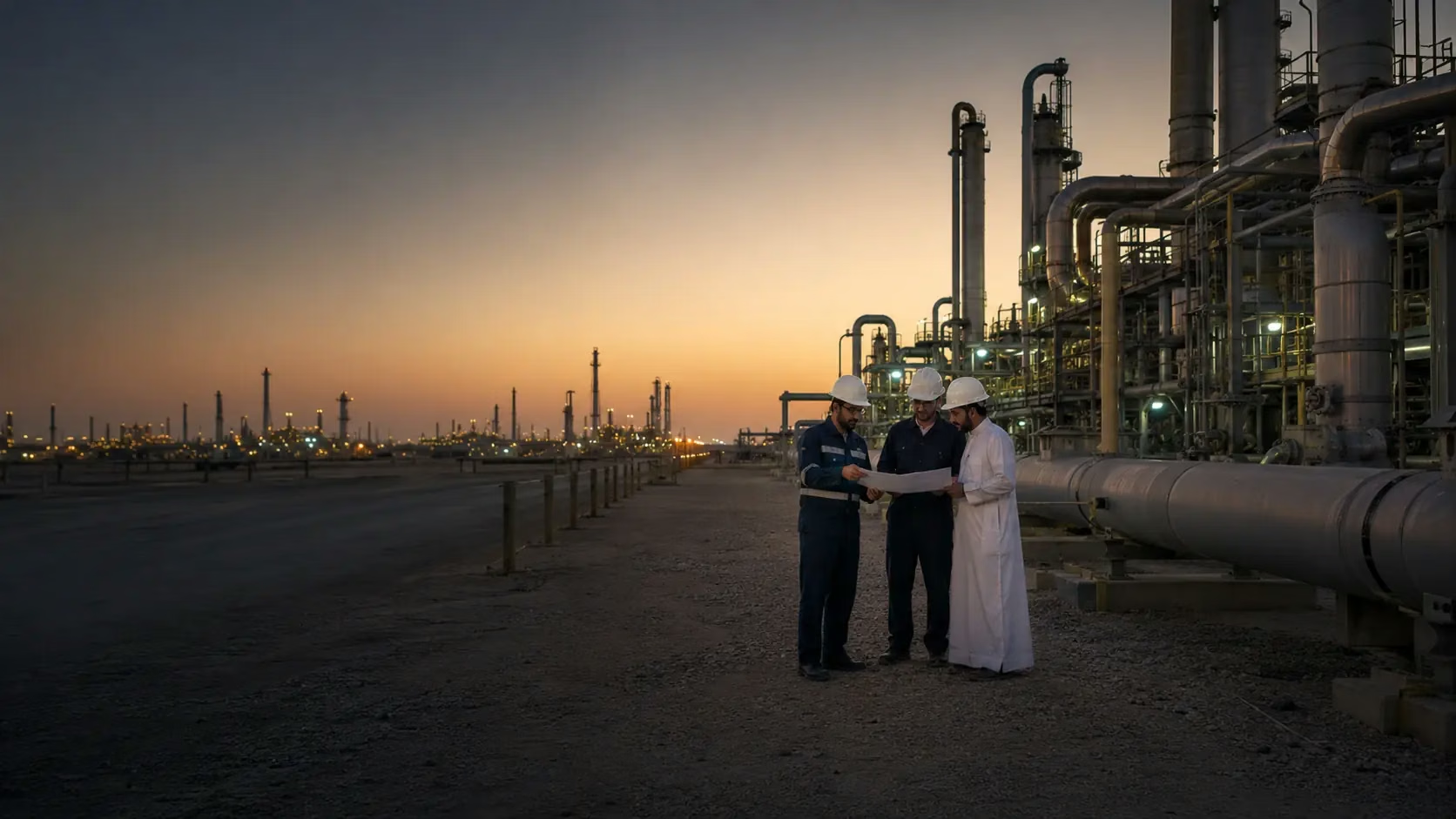
For HAL Trust, Technip Energies is a significant listed investment: the holding company owned 19.15% as of June 30, 2026 (18.3% at the end of 2025, with a market value of €1.058 billion). The announcement of two long-term agreements with Saudi Aramco is therefore noteworthy. However, it should be properly translated: Technip is joining two pools of suppliers for five years; it is not receiving a firm five-year contract today.
In summary
The first agreement covers upstream design and project management consulting services. The second targets EPC work on existing onshore facilities. Both are five-year agreements. They could fuel future Technip Energies volumes and deepen its relationship with Aramco, but no amounts have been disclosed and each contract has yet to be awarded.
Why this matters to the HAL Trust shareholder
At the end of 2025, the Technip Energies holding represented approximately 6.4% of HAL's net asset value, and the holding company was a major shareholder. Therefore, improved commercial visibility, increased orders, or an improved service mix can be reflected in HAL's net asset value through the market capitalization of the investment and, ultimately, through its dividends. However, the framework agreement itself does not justify any immediate addition to the order book.
Two entry points into the project chain
The first agreement positions Technip Energies among the potential providers of upstream engineering services and project management consultancy. It can cover energy, downstream oil and gas, petrochemicals, and low-carbon projects. This work takes place early in the cycle: project definition, studies, supervision, and coordination.
The second agreement concerns engineering, procurement, and construction at existing onshore facilities. The term "brownfield" is key. It involves connecting, upgrading, or modernizing assets already in operation: pipelines, wells, control systems, power supply, and associated infrastructure. These operations are often smaller than a new megaproject, but potentially numerous and recurring.
Both agreements thus cover the two ends of Technip Energies' expertise: project design and execution. They extend a presence in Saudi Arabia dating back to the 1970s and can foster an ongoing business relationship with the world's largest oil producer.
A business opportunity in an already crowded group
Technip Energies is not approaching these agreements with an empty order book. As of June 30, 2026, its adjusted backlog reached a record €25.0 billion, up 57% since December and equivalent to approximately three years of revenue. Order intake for the first half of the year reached €12.7 billion, driven in particular by major LNG projects.
This depth is reassuring for future revenue, but it shifts the focus to execution. Adjusted revenue for the first half remained stable at €3.653 billion, while recurring EBITDA declined by 33% to €212 million. The Project Delivery segment's margin was impacted by operational and contractual difficulties related to the Middle East.
The Aramco agreements thus offer a further pool of opportunities, but in the very region where Technip has recently suffered costs and disruptions. They are not insurance against geopolitical risk; rather, they increase the importance of contract selection, legal safeguards, and local execution.
The detail that the headline should not obscure
Technip is not alone. According to MEED, Aramco has selected eleven local and international companies for the PMC pool and eighteen for the brownfield EPC works. Being selected qualifies the company; it does not guarantee it a fixed share. Future lots could be contested with Fluor, Wood, Worley, Sinopec, Técnicas Reunidas, and other competitors.
The five-year term has strategic value: it reduces the need to requalify for each opportunity and keeps Technip aligned with Aramco's investment program. However, it does not provide the same financial visibility as a signed order book. The correct term is "multi-year access to opportunities," not "a guaranteed five-year contract."
The positive signal
Two complementary positions, a long-standing relationship, and sustained access to both consulting and execution projects.
Control Point
No minimum amount, no minimum volume, multiple competitors, and a regional environment that has already impacted margins.
Opulation Reading
HAL shareholders must resist the simplistic headline. A framework agreement is not a book of business. It is a commercial option: valuable if Technip Energies wins profitable lots, with no quantifiable value before they are awarded.
Interest in HAL remains strong, as Technip Energies is large enough to impact its net assets. The best indicator will not be the number of press releases, but the orders actually placed, their mix between services and EPC, and then the margins achieved.
Sources
Share this article