Analysis · Exor N.V.
Exor: At Philips, AI Moves from Talk to Clinical Measurement
Preliminary results on 3D Auto CFQ do not yet allow for sales forecasts. However, they provide Exor's shareholder with a preliminary clinical signal on the intersection of healthcare and technology, justifying its large stake in Philips.
Courtesy translation of the French original.
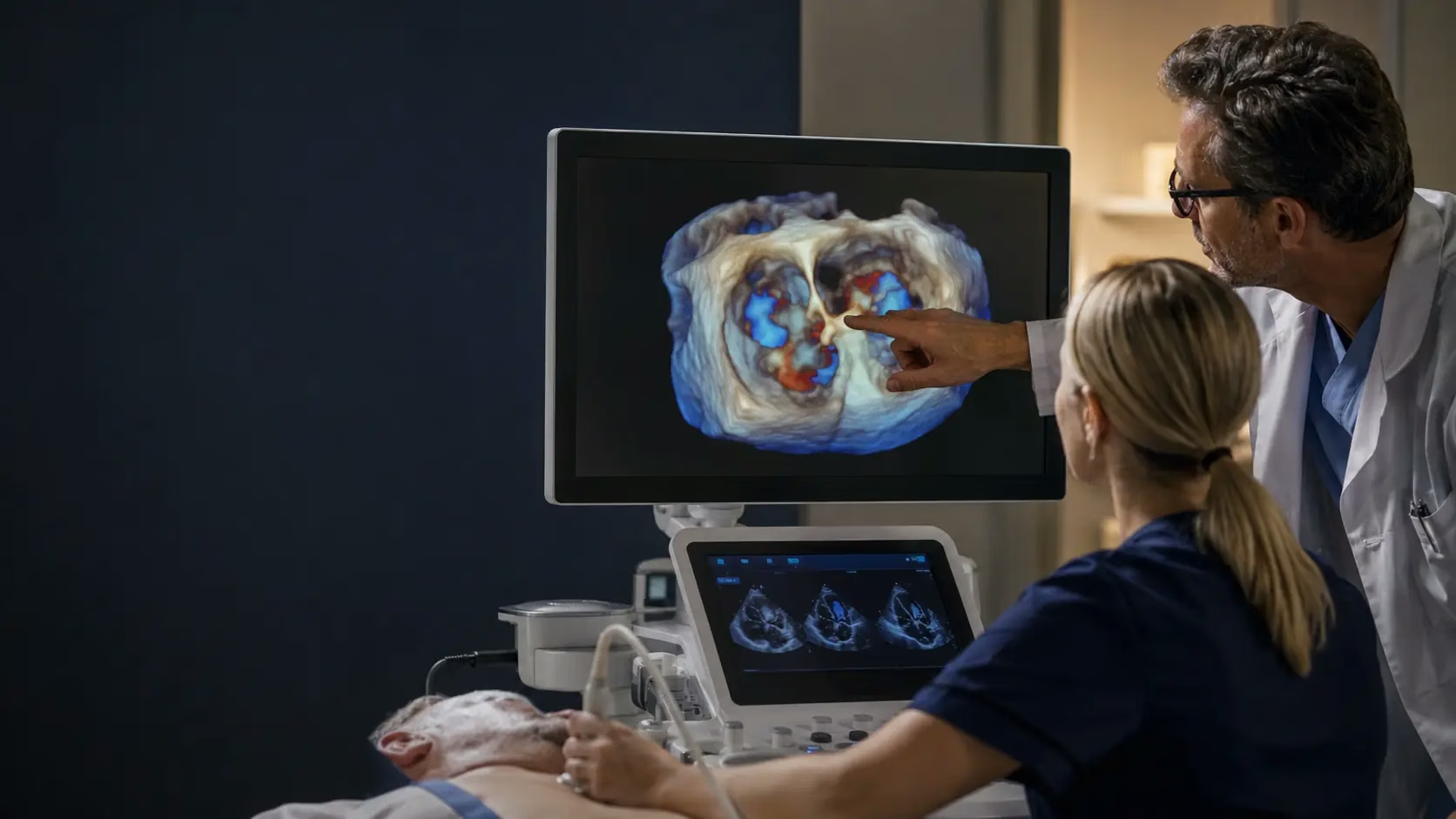
The term “artificial intelligence” now appears in almost every corporate presentation. For a holding company like Exor, the challenge isn’t counting mentions. It’s identifying the moment when an algorithm improves a measurable clinical task, on a device that hospitals can actually use. The data unveiled by Philips at the European Society of Cardiology Congress provides precisely this transition from narrative to preliminary clinical signal.
The Essentials
In an ongoing prospective, multicenter, international study, Philips' 3D Auto CFQ technology produced mitral regurgitation measurements closer to those obtained with magnetic resonance imaging than the conventional 2D PISA echocardiographic method. The preliminary bias reported is +7 mL, compared to +14 mL. For Exor, which valued its 19% stake in Philips at €4.24 billion at the end of 2025, this data supports the "health plus technology" thesis-without yet proving adoption, revenue, or improved patient outcomes.
Why this matters to Exor
Philips represented 11.4% of Exor's gross assets at the end of 2025, second only to Ferrari and practically on par with Stellantis. Exor held 19.0% of the economic rights and 19.2% of the voting rights, with a proposed representative on the supervisory board. This is therefore a strategic stake, chosen to strengthen the holding company's exposure to healthcare and technology. The question is not whether Philips is "doing AI," but whether this AI sufficiently improves its medical portfolio to support growth, margins, and hospital loyalty.
The clinical problem behind the algorithm
Mitral regurgitation occurs when the mitral valve does not close properly and allows blood to flow back up. Measuring the severity of this leak guides monitoring and treatment decisions. However, the 2D echocardiographic PISA method relies on geometric assumptions and images taken at a single point in time. It can be less accurate when jets are multiple, eccentric, or change during heart contraction.
3D Auto CFQ uses three-dimensional transesophageal echocardiography to reconstruct and track the flow convergence zone throughout systole. The software thus attempts to account for variations in the orifice and multiple jets, rather than reducing the phenomenon to a fixed geometry.
How the clinical signal can be traced back to Exor
- 1The algorithm measures better.Preliminary results are closer to the MRI reference standard.
- 2The clinician gains confidence.More consistent quantification can facilitate the monitoring of complex cases.
- 3Philips equipment becomes more useful.If the evidence is confirmed, the software can enhance the value of the installed ultrasound ecosystem.
- 4The Exor thesis becomes testable.Adoption, software revenue, renewals, and profit margin will determine whether the clinical innovation translates into economic value.
An encouraging, but still incomplete, signal.
Philips reports better agreement with magnetic resonance imaging, considered here as the reference method: bias of +7 mL versus +14 mL and a published correlation of ρ = 0.77 for regurgitant volume. The study also examined, for the first time, the reclassification of severity according to the two methods.
But the press release does not provide, in its summary, the sample size, confidence intervals, details of the subgroups, or the final results. These are preliminary data presented at a conference, from an observational study that is still ongoing. They demonstrate neither a reduction in hospitalizations, nor better long-term outcomes, nor economic superiority.
This caution does not diminish the significance of the milestone. It puts it in its proper perspective: a signal of clinical validation, situated between technical performance in the laboratory and daily adoption by physicians.
What becomes more credible
Philips' AI can overcome a specific limitation of traditional ultrasound and strengthen the differentiation of its cardiology systems.
What remains to be demonstrated
Final validation, authorization and deployment according to markets, clinical adoption, revenue model and impact on margins.
The real asset: the combination of hardware, data, and workflow
A startup can develop a good algorithm. Philips also has installed devices, hospital relationships, regulatory teams, and a presence in the clinical pathway. If 3D Auto CFQ integrates seamlessly into existing consoles and workflows, distribution can become as important as mathematical performance.
This is where the stake in Exor sheds light on the situation. The holding company didn't acquire a pure software publisher; it chose a medical technology group capable of attaching AI to hardware, data, and care decisions. The potential value creation comes from this integration-greater utility per device, software or service revenue, customer loyalty, and renewals-rather than simply an "AI-powered" label.
This chain remains a hypothesis. Philips has not provided pricing information, a compatible user base, a launch schedule, or an expected impact on sales. The study validates a function; it does not yet validate its economic viability.
Opulion Reading: A Small Data Point for a Big Thesis
At 11.4% of gross assets, Philips is a significant player for Exor. Investors should therefore follow the evidence that either confirms or undermines the promise made at the time of the initial investment: to build value at the intersection of healthcare and technology.
The 3D Auto CFQ provides interesting evidence because it starts with a concrete medical problem and compares its measurement to an established benchmark. It doesn't currently change Exor's NAV. However, it offers a more useful indicator than a generic press release on AI: if the final data holds up, if clinicians adopt the tool, and if Philips can monetize it, the holding company's strategic thesis will progress from a clinical demonstration to an economic reality.
Not to be overinterpreted
To watch
- 1Point to watchthe full publication of the study, its size, and confidence intervals;
- 2Area to watchValidation in different types of mitral regurgitation;
- 3Area to watchRegulatory status and commercial availability timeline;
- 4Area to watchThe number of compatible systems and the pricing model;
- 5Area to watchEarly signs of adoption and impact on Philips' software mix.