News · Ackermans & van Haaren NV
SIPEF targets 70,000 tonnes of bananas: what Tiabam changes for Ackermans & van Haaren
The acquisition potentially adds 12,000 to 14,000 tonnes to a business that remains small within SIPEF. More importantly, it arrives as AvH turns its long-standing stake into the foundation of a broader Food & Agri platform.
Courtesy translation of the French original.
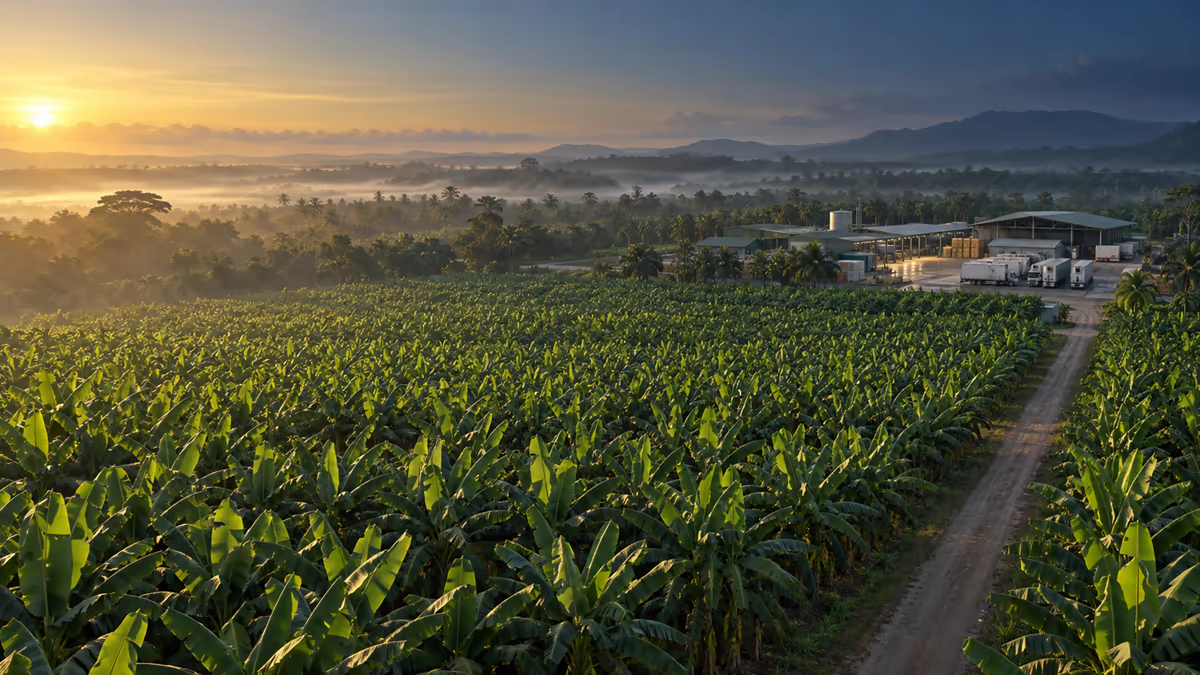
SIPEF has signed an agreement to acquire the Tiabam banana plantation in Tiassalé, Côte d'Ivoire. The asset covers approximately 450 hectares, including 320 hectares in production, employs around 400 people and produces between 12,000 and 14,000 tonnes of bananas each year. More than 70% of this output is exported to Europe. Closing is expected later in September 2026.
For an Ackermans & van Haaren shareholder, the right question is not whether bananas suddenly become the group's main earnings engine. They do not. The relevant questions are why AvH continues to increase its commitment to SIPEF, how Tiabam changes the scale of SIPEF's banana operation and whether the transaction confirms the emergence of a broader agricultural platform.
The answer has three parts. Tiabam is material to SIPEF's banana business, but still modest within SIPEF as a whole. Its proximity to the existing Akoudjé operations may improve industrial efficiency. Finally, the deal comes at a time of weaker European banana prices, making execution and the undisclosed purchase price the decisive variables.
The fact pattern, without overreach
On 7 September 2026, SIPEF announced that its subsidiary Plantations J. Eglin had reached an agreement with AGRIBAM to acquire Tiabam. The plantation is adjacent to SIPEF's existing Akoudjé operations. SIPEF points to potential procurement, logistics and export synergies, together with the gradual introduction of its agronomic and operational practices.
Tiabam already holds GLOBALG.A.P. and Rainforest Alliance certifications. SIPEF plans targeted investment in social infrastructure, health and safety, irrigation, equipment and replanting. This indicates that the buyer is not merely acquiring existing tonnage. It also intends to improve the asset's quality, resilience and productivity.
What SIPEF does not disclose matters just as much. The acquisition price is unknown. It is therefore impossible to calculate a price per hectare, a price per tonne of capacity, a return on invested capital or potential value creation relative to market multiples. The precise financing of the transaction is not described either.
A genuine change of scale in bananas
SIPEF produced 52,159 tonnes of bananas in 2025. Before announcing Tiabam, it expected approximately 55,000 tonnes in 2026. Its new ambition is to lift banana production to around 70,000 tonnes.
Moving from 52,159 to 70,000 tonnes represents 34.2% growth. Relative to the pre-Tiabam 2026 outlook, the remaining increase is 15,000 tonnes, or 27.3%. Tiabam's disclosed current output accounts for most, but not necessarily all, of that distance. The balance may come from yield improvements, replanting or other expansion. SIPEF has not yet provided a detailed timetable separating those contributions.
This increase in scale matters for three reasons. First, banana exports carry fixed costs for packing, quality control, inland transport and the cold chain. Additional volumes may improve cost absorption. Second, physical adjacency reduces the risk of creating an isolated operation. Third, more than 70% of Tiabam's production already goes to Europe, limiting the commercial work required to open distribution channels.
Caution remains necessary. Of the 450 hectares, 320 are currently in production. The remaining 130 hectares are not automatically plantable reserves. Agronomic, environmental and social constraints have not been detailed. Tiabam's implied productivity, between 37.5 and 43.8 tonnes per producing hectare, is a useful indicator, not a guarantee of future yield.
The paradox: more volume as prices decline
The transaction arrives as the European banana market becomes less supportive. SIPEF reported an average CFR Europe market reference of EUR 799 per tonne in the first half of 2026, down from EUR 900 a year earlier. That is an 11.2% decline. After a strong first quarter, the second quarter was affected by abundant supply, softer demand and congestion at the Port of Abidjan.
Yet SIPEF's banana segment revenue increased by 24% in the first half to USD 27.8 million, mainly because of higher volume. Banana output grew 9.4% to 28,429 tonnes. This illustrates both the strength and the limitation of the strategy: volume can cushion a price decline, but it does not eliminate cyclicality or logistics risk.
The visible engine
SIPEF banana production reached 28,429 tonnes in the first half of 2026.
The headwind
The CFR Europe reference declined from EUR 900 to EUR 799 per tonne.
The offset
Banana segment revenue reached USD 27.8 million, mainly thanks to volume.
The limit
Bananas represented approximately 9% of first-half consolidated revenue.
The conclusion is not that SIPEF is betting on an immediate price recovery. The most robust rationale is industrial: acquire an adjacent plantation, integrate output already directed toward Europe and improve fixed-cost absorption. This remains an inference until SIPEF discloses the price, quantified synergies and a margin path for the combined banana operation.
What the transaction means for Ackermans & van Haaren
SIPEF contributed EUR 22.1 million to AvH's consolidated result in the first half of 2026. This represented 6.5% of group net profit and 6.9% of the contribution from its core segments. Within Energy & Resources, SIPEF accounted for almost the entire contribution, EUR 22.1 million out of EUR 22.3 million.
That segment concentration must be placed in the context of AvH's full portfolio. SIPEF is a meaningful contributor, not a dominant one. Bananas, in turn, represented only around 9% of SIPEF's first-half revenue. An increase of more than 20% in banana capacity therefore does not flow through to AvH's result in the same proportion.
The economic transmission is a chain of fractions: Tiabam is only part of the banana segment, bananas are only part of SIPEF, and AvH owns 43.32% of SIPEF. This dilution prevents the transaction from being presented as an immediate transformation of AvH's intrinsic value.
The strategic direction is more interesting than the near-term accounting effect. AvH spent EUR 10.9 million buying additional SIPEF shares during the first half, raising its ownership from 42.20% to 43.32%. In parallel, it announced an investment of approximately EUR 93 million for a 37.5% stake in Grieg Aqua, described as broadening a Food & Agri platform built around SIPEF.
Tiabam fits that sequence. AvH increases its exposure to SIPEF. AvH adds aquaculture to its agricultural portfolio. SIPEF, in turn, consolidates an existing food business in Côte d'Ivoire. This is not yet a standalone segment in AvH's reporting, but the capital movements are beginning to form a coherent whole.
Tiabam does not transform AvH through its size. It matters because it shows how a long-standing investment is gradually becoming the nucleus of a broader Food & Agri platform.
Balance-sheet capacity helps, but price will determine value creation
SIPEF had net cash of USD 124.5 million at 30 June 2026. Its annual investment programme of USD 100 million to USD 120 million was expected to be fully funded by operating cash flow. AvH, meanwhile, reported EUR 524.4 million of net cash at the same date.
These figures make the acquisition appear absorbable for both balance sheets. They do not prove that it is attractive. A transaction can be affordable and still deliver an inadequate return. Without a price, the denominator required for every useful return calculation is missing.
Shareholders should therefore look for four disclosures in future reporting: the total price including upgrading investment; the timetable to reach 70,000 tonnes; the change in logistics cost per tonne; and the normalised operating margin of the banana business at different European price levels.
Industrial logic
Tiabam is next to Akoudjé and already exports more than 70% of its output to Europe.
Scale effect
SIPEF identifies these synergies but has not quantified them.
Impact on AvH
Bananas are about 9% of SIPEF revenue, and AvH owns 43.32% of SIPEF.
Price discipline
The purchase price and quantified upgrading plan have not been disclosed.
The Opulion view
Tiabam is an understandable acquisition, but not yet a transaction that can be valued. It significantly increases the scale of SIPEF's banana operation, benefits from credible geographical proximity and brings volumes already directed toward Europe. It also comes when weaker prices are a reminder that bananas remain an agricultural, cyclical and logistics-intensive business.
For AvH, the message is less spectacular and more structural. SIPEF remains a minority but tangible earnings contributor. The recent ownership increase, the investment in Grieg Aqua and SIPEF's own expansion point to a firmer allocation of capital toward Food & Agri. Tiabam is one building block, not final proof.
The next test will be financial. If SIPEF reports a disciplined price, a credible timetable and measurable synergies, the transaction could illustrate value creation through densifying an existing platform. Until those items are known, the conclusion must remain proportionate: the strategic logic is visible, the economic return is not.
Sources
Share this article