News · SoftBank Group Corp.
SoftBank borrows JPY 1 trillion and sells a slice of Meesho: the two sides of funding physical AI
Official LTV fell to 13.0%, yet adjusted net debt rose 63% in a year. The ABB Robotics bond, OpenAI bridge loans and Meesho sale reveal a leverage cycle that remains manageable but increasingly depends on Arm's value.
Courtesy translation of the French original.
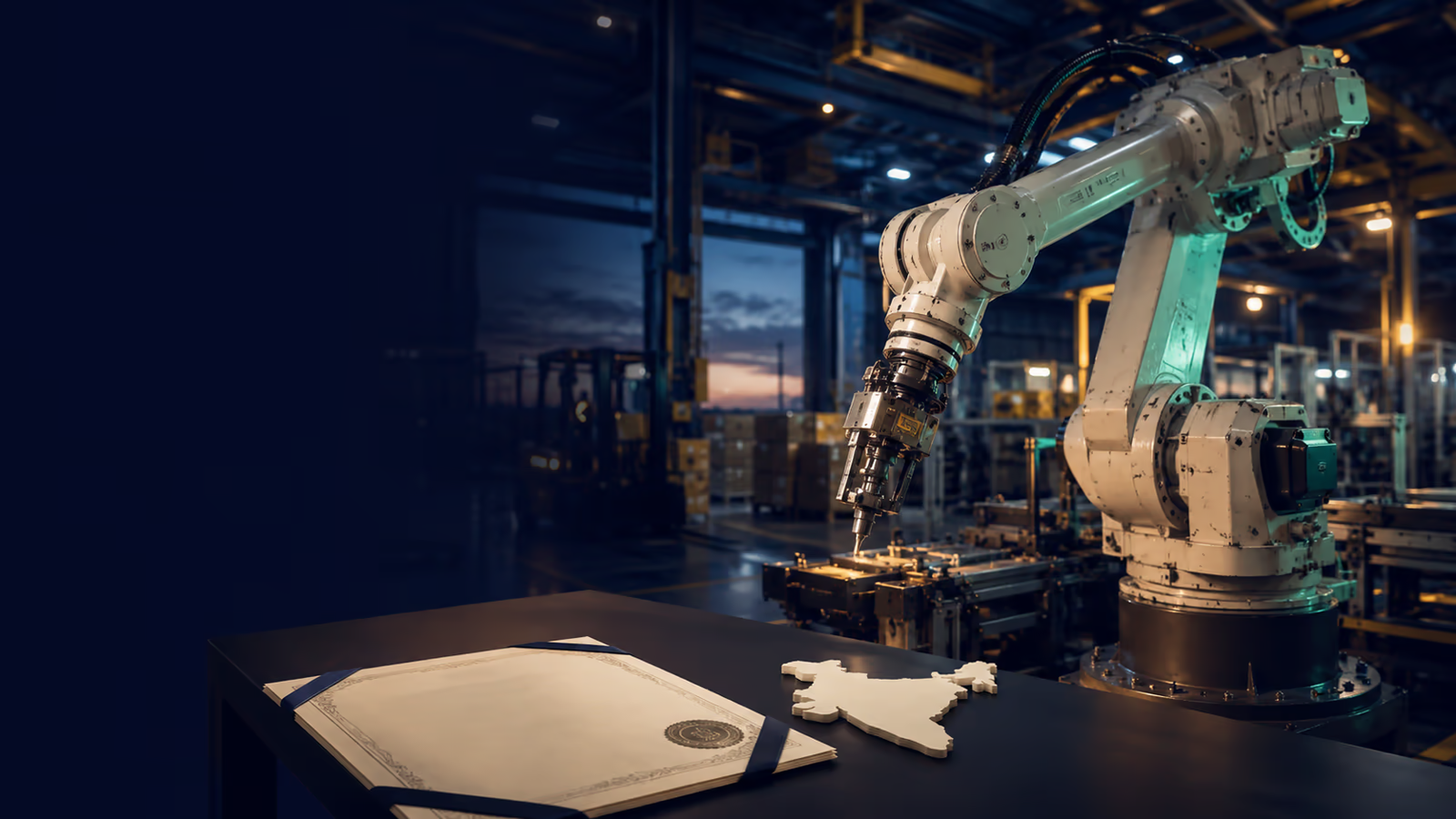
For SoftBank Group shareholders, the important information on September 4 is not merely a 4.75% coupon. It is the overall movement. The holding company is borrowing JPY 1 trillion, partly to acquire ABB Robotics, while turning an Indian investment that has become liquid into cash. On one side, it is using the balance sheet to own an industrial robotics platform. On the other, it is selling 80 million Meesho shares for approximately INR 16.5 billion.
The two transactions are not comparable in size. Translated at SoftBank's June 30 dollar-yen rate, the Meesho sale represents approximately JPY 28 billion, or less than 3% of the new bond. Yet their juxtaposition captures the method. SoftBank is recycling assets from its previous generation into the models, chips, data centers and now robotics that make up its artificial intelligence strategy.
The real question is therefore this: has SoftBank's debt entered a new upward cycle linked to AI and robotics? The short answer is yes in absolute debt terms, but not yet in the risk measure the group itself emphasizes. That apparent contradiction deserves to be unpacked.
The essentials
Yes, debt is rising. No, LTV does not show it yet
SoftBank defines LTV as adjusted parent-company net debt divided by the adjusted equity value of holdings. At June 30, 2026, the numerator was JPY 10.81 trillion and the denominator JPY 83.11 trillion, producing a 13.0% ratio.
The official quarterly series is more informative than the latest ratio alone.
| Period end | Equity value of holdings | Adjusted net debt | LTV |
|---|---|---|---|
| June 2025 | JPY 39.05tn | JPY 6.64tn | 17.0% |
| September 2025 | JPY 39.87tn | JPY 6.56tn | 16.5% |
| December 2025 | JPY 38.98tn | JPY 8.05tn | 20.6% |
| March 2026 | JPY 48.26tn | JPY 8.21tn | 17.0% |
| June 2026 | JPY 83.11tn | JPY 10.81tn | 13.0% |
Over one year, adjusted net debt increased by JPY 4.17 trillion, or 63%. LTV nevertheless fell by four percentage points. The reason sits in the denominator: the adjusted equity value of holdings rose 113%. Arm alone increased from JPY 19.15 trillion in March to JPY 49.91 trillion in June after the adjustment for asset-backed financing.
In other words, the balance sheet took on more debt while the ratio improved. This is not a calculation anomaly. It is the mechanical result of asset values increasing much faster than debt.
OpenAI is the first driver of the increase
The link to artificial intelligence is no longer an inference. In March, SoftBank signed a USD 40 billion bridge facility primarily to finance its follow-on investments in OpenAI. During the first quarter of its fiscal year, the group borrowed USD 20 billion, repaid USD 3.6 billion and had USD 16.4 billion outstanding at June 30.
On July 1, it drew another USD 10 billion, equivalent to JPY 1.627 trillion, to execute the second OpenAI tranche. A third USD 10 billion tranche is scheduled for October 1. SoftBank has explicitly said that these bridge loans will gradually be replaced through existing assets and other financing measures.
The numerator is therefore already moving higher, even if its form changes: a bridge loan today, asset sales or longer-dated debt tomorrow. Debt is not a one-off feature of a single acquisition; it is becoming one of the permanent bridges between the legacy portfolio and SoftBank's new AI architecture.
The repayment schedule makes this visible. In the table published after June and adjusted to include the July drawdown, SoftBank shows JPY 4.86 trillion of fiscal 2026 maturities, including approximately JPY 4.29 trillion of bridge loans. This is not necessarily a cash repayment wall: a bridge loan is designed to be refinanced. It does, however, make replacement funding capacity as important as the headline LTV.
ABB Robotics adds a second destination for the balance sheet
SoftBank announced in October 2025 that it would acquire 100% of ABB Robotics for USD 5.375 billion, equivalent to approximately JPY 818.7 billion at the exchange rate used in the release. The new JPY 1 trillion unsecured bond matures on September 16, 2033 and carries a 4.75% coupon. Its proceeds will repay domestic bonds and partly finance the acquisition.
Our first French-language article on SoftBank's 70th bond analyzed the scale of the offering, its reliance on Japanese households and its higher cost relative to the December 2025 issue. The September 4 release supplies the two missing pieces: the final rate and use of proceeds. This article therefore addresses the next part of the story: not only the price of debt, but its place in the holding company's financial structure.
The contractual annual coupon is JPY 47.5 billion. Over seven full years, nominal coupons would total JPY 332.5 billion, before tax, any early repurchase and the time value of money. The entire amount should not be attributed to ABB Robotics because part of the issue replaces existing debt.
An illustrative scenario shows the order of magnitude. A JPY 400 billion domestic bond carrying a 1.38% coupon matures on September 17. If the new issue refinanced exactly that amount, which SoftBank has not officially broken out, the remaining JPY 600 billion could fund ABB Robotics. In this scenario, the annual coupon on the refinanced slice would rise from JPY 5.52 billion to JPY 19 billion, an increase of JPY 13.48 billion, while the acquisition funding slice would cost JPY 28.5 billion annually.
What SoftBank confirms
The bond raises JPY 1tn for seven years at 4.75%; proceeds combine repayment of domestic debt and partial funding for ABB Robotics.
What we test
JPY 400bn of refinancing and JPY 600bn of acquisition funding because a JPY 400bn bond matures on the issue date. This allocation is illustrative, not disclosed.
Meesho: useful for understanding the method, small for the balance sheet
On September 3, SVF II Meerkat sold 80 million Meesho shares at INR 206.30, according to market data reported by Indian media. Proceeds were INR 16.504 billion, or approximately USD 174 million. The stake would decline from approximately 8.60% to 6.87% if all the shares came from that vehicle.
At SoftBank's June 30 dollar-yen rate of 162.39, USD 174 million translates into approximately JPY 28.3 billion. That is 2.8% of the new bond principal and 3.5% of ABB Robotics' historical yen purchase price. The sale therefore does not come close to funding the acquisition on its own.
It still has analytical value. Meesho was a private asset, became listed in December 2025 and can now be monetized in blocks. SoftBank is turning that liquidity into room for new bets. At the moment of sale, the LTV mechanics are approximately neutral: the value of the holding falls, cash rises and reduces net debt. Value creation or destruction depends mainly on the sale price relative to the portfolio carrying value and on the future use of the cash.
Moving from a minority Indian investment to a controlled industrial business nevertheless changes the nature of risk. Meesho offered financial exposure to a commerce platform. ABB Robotics will require integration, operating expenditure, technological coordination and commercial execution. SoftBank is exchanging a fraction of a liquid asset for strategic infrastructure that would be harder to sell quickly.
Our estimate: LTV remains comfortable, but rises after deployment
The 13.0% LTV is a June 30 snapshot. It predates the July 1 USD 10 billion draw and the future ABB Robotics cash payment. To test the direction of travel, we built a purely mechanical bridge with no market movements.
| Illustrative step | Adjusted net debt | Equity value of holdings | Mechanical LTV |
|---|---|---|---|
| Published June 30 starting point | JPY 10.81tn | JPY 83.11tn | 13.0% |
| After July OpenAI tranche, recognized at cost | JPY 12.44tn | JPY 84.74tn | 14.7% |
| After October USD 10bn OpenAI tranche at contractual FX | JPY 14.00tn | JPY 86.30tn | 16.2% |
| After JPY 600bn of ABB net debt and adding the asset at announced price | JPY 14.60tn | JPY 87.11tn | 16.8% |
The Meesho sale would change the final ratio by less than one tenth of a percentage point in this model. Its significance is strategic, not arithmetic.
This bridge is not a forecast. It assumes each investment is immediately added to the denominator at cost, the new bond refinances JPY 400 billion and funds ABB with JPY 600 billion, and no other disposal, debt, currency move or revaluation occurs. Actual accounting will differ. The exercise nevertheless answers the directional question: with asset prices unchanged, the announced deployment would push LTV back toward 17%, not 25%.
SoftBank targets LTV below 25% in normal conditions and sets 35% as an upper threshold even in an emergency. In our mechanical scenario, the group would remain approximately eight points below the normal threshold. It has headroom, but part of that headroom comes from Arm's market value and OpenAI's private valuation.
The risk is not only debt: it is concentration in the denominator
At June 30, Arm represented JPY 49.91 trillion of SoftBank's JPY 83.11 trillion adjusted equity value of holdings. SVF2 represented another JPY 19.29 trillion, with OpenAI becoming increasingly central. Both sides of LTV are therefore connected to the same thesis: SoftBank borrows to increase AI exposure while rising AI asset values keep the ratio low.
That circularity works extremely well in a rising market. It becomes more demanding if Arm corrects, OpenAI is marked down or physical projects consume capital before producing cash. A bond does not revalue downward because a share price falls: the JPY 47.5 billion coupon remains due.
The right measure of discipline will therefore not be the next LTV alone. Investors need to track three lines together: adjusted net debt in absolute terms, the share of Arm and OpenAI in the denominator, and the ability of the new physical assets to generate cash after interest.
Opulion view: the cycle has started, the danger has not
Yes, SoftBank has entered a rising debt cycle linked to artificial intelligence. The increase from JPY 6.56 trillion to JPY 10.81 trillion since September 2025, the OpenAI bridge facility, the July draw and ABB Robotics financing demonstrate it. Robotics is not yet the main driver of leverage; OpenAI is. ABB, however, extends the movement from software AI into physical AI.
No, the published figures do not currently show balance-sheet stress relative to SoftBank's own limits. The 13.0% LTV remains low and our deployment scenario stays below 17%. The caution signal lies elsewhere: falling LTV masks a rapidly rising numerator, and the safety margin increasingly depends on a small number of technology assets.
The Meesho sale barely changes the ratio. It does show how SoftBank intends to fund the cycle: borrow, extend maturities, refinance bridge loans and gradually monetize holdings that have become liquid. For shareholders, the decisive question is not whether SoftBank can raise more debt. It is whether the value and cash flows created by OpenAI, ABB Robotics and the associated infrastructure will grow faster than the fixed obligations accumulated to fund them.
What to watch
- 1Next official LTVSeparate the change in net debt from changes in Arm's and OpenAI's value.
- 2Bridge loan replacementIdentify which disposals and long-term debts refinance the USD 26.4bn of drawings included in the adjusted maturity schedule.
- 3Use of the 70th bondDetermine the exact share of JPY 1tn allocated to refinancing and to ABB Robotics.
- 4ABB closingMeasure the final price, assumed net debt and cash-flow contribution of the new subsidiary.
- 5Indian recyclingTrack residual Meesho and other listed-asset sales and compare prices with portfolio carrying values.
Sources
- SoftBank Group - official NAV and LTV calculation at June 30, 2026.
- SoftBank Group - quarterly data, LTV history and debt maturity schedule, August 2026.
- SoftBank Group - final terms of the 70th unsecured bond, September 4, 2026.
- SoftBank Group - execution of the second OpenAI tranche and bridge drawdown, July 1, 2026.
- SoftBank Group - OpenAI follow-on investment and financial policy, February 27, 2026.
- SoftBank Group - ABB Robotics acquisition, purchase price and operating data, October 8, 2025.
- Economic Times - sale of 80 million Meesho shares based on NSE data, September 4, 2026.
Share this article