News · Brederode S.A.
Two power deals reveal what Brederode really owns in Alphabet
Geothermal in Utah, solar and batteries in West Virginia: behind AI, Alphabet is becoming an organizer of energy infrastructure available day and night.
Courtesy translation of the French original.
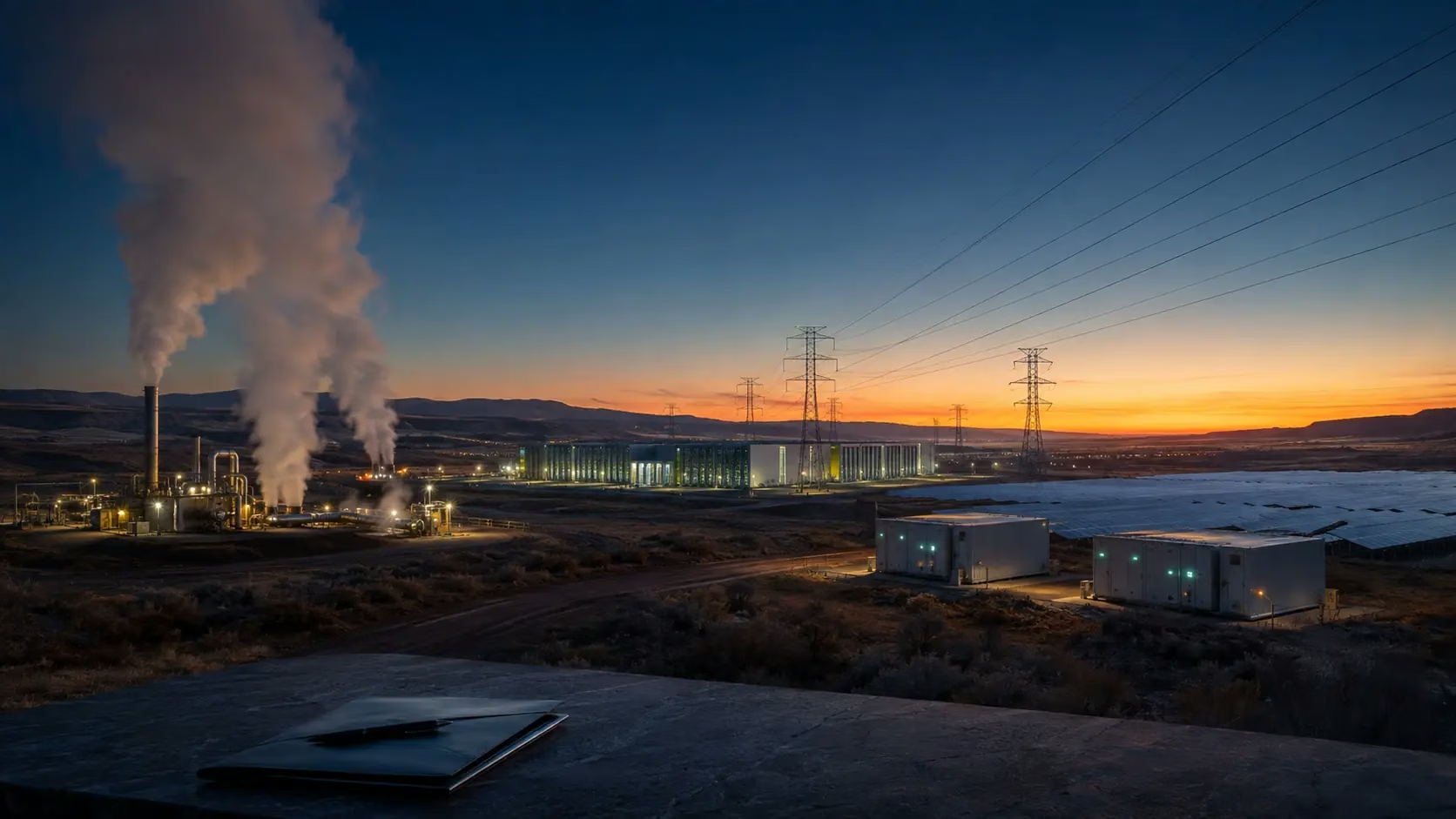
Alphabet was Brederode's largest listed holding as of March 31, 2026: €220.45 million, 14.5% of the listed portfolio and approximately 5.3% of equity. When Google signs two energy devices for future data centers, Brederode gains indirect exposure to the ability to reserve electricity before computing needs it.
The essentials
Google will purchase 396 MW of geothermal capacity from Fervo Energy for a project expected to be completed in 2028 in Utah, with an option to expand the potential total to nearly 1 GW by June 2030. In parallel, an MN8 project in West Virginia will combine 86 MW of solar power, 70 MW/280 MWh of lithium-ion batteries, and 10 MW/100 MWh of zinc batteries. Neither deal guarantees the construction of the data centers or their timeline; they demonstrate how Alphabet treats energy as a strategic input.
Why this news matters for Brederode
Brederode's investor owns more than just a search engine, YouTube, or an AI model. Through its first listed holding, it also owns a company that must convert billions of dollars of IT investments into usable capacity. Chips are worthless without power, network connectivity, and cooling. These agreements are not yet generating a quantifiable profit, but they mitigate a physical risk that could limit Alphabet's growth.
Utah: Industrializing dispatchable geothermal energy
Fervo is adapting techniques from horizontal drilling and rock stimulation to geothermal energy. The goal is to access underground heat in more locations than conventional geothermal energy. Its Cape Station project is slated to deliver 396 MW to Google starting in 2028. The contract is touted as the largest enhanced geothermal power purchase agreement to date.
The most interesting detail is the option: Google will be able to add approximately 600 MW by June 2030, bringing its total capacity close to 1 GW. Initial contracted capacity supports development; the option retains flexibility should needs, technology, and permits align. The computing site remains subject to technical feasibility, local approvals, and commercial terms.
The relationship isn't starting from scratch. A 3 MW pilot project has been operating in Nevada since 2023, and a 115 MW agreement was signed in 2024 with Fervo and NV Energy. Google is thus moving from testing to industrial-scale capacity, leveraging its demand to accelerate the technology's expansion.
West Virginia: Making Solar Power Available for Longer Periods
The second project addresses the same problem with a different combination. MN8 plans for 86 MW of solar power on a former coal mine, 70 MW/280 MWh of lithium-ion batteries, and 10 MW/100 MWh of zinc storage supplied by Eos. The lithium battery can supply electricity for approximately four hours at full power; the zinc battery is designed for ten hours. The two durations are complementary.
Google will purchase the energy, capacity, and clean energy attributes of the project, intended for the PJM network and regional data centers. Deployment is phased: solar in 2028, lithium-ion in 2029, and then zinc in 2030. This is infrastructure to be built, not megawatts already available.
The educational visual: two routes to the same useful megawatt
| Project | Architecture | Announced schedule | Role for Alphabet |
|---|---|---|---|
| Fervo · Utah | 396 MW of enhanced geothermal, plus an option for approximately 600 MW | First deliveries expected in 2028; option until June 2030 | Decarbonized, dispatchable electricity for a potential data center |
| MN8/Eos · West Virginia | 86 MW solar + 70 MW/280 MWh lithium + 10 MW/100 MWh zinc | 2028 for solar, 2029 for lithium, 2030 for zinc | Transforming intermittent production into available capacity over more hours |
What this changes - and what it doesn't change
These agreements improve visibility into future energy access, but do not allow for the calculation of a return on investment for Alphabet. Purchase prices, guarantees, consumption profiles, and minimum commitments are not disclosed. The local economic estimates published by MN8 do not provide information on Google's profitability.
The execution risk remains significant: permits, grid connection, drilling, costs, and timeline. Zinc storage would be the first long-term commercial installation of this scale in West Virginia. Its novelty is both its appeal and its risk.
Other hyperscalers are also signing major agreements. Alphabet's potential advantage will lie in the quality of the projects, their execution, and the total cost of electricity. For Brederode, this is a leading indicator, not yet financial proof.
What we learn
The agreements with Fervo and MN8 show Alphabet securing several technologies and delivery horizons to power its growth. Through Alphabet, Brederode therefore has indirect exposure to AI's physical supply chain.
What remains to be demonstrated
Permits, grid connections, drilling, storage and costs remain execution risks. The contracts do not yet establish a cost advantage or a financial effect for Alphabet, let alone Brederode.
Brederode's reading: making the invisible visible
Brederode publishes a position in Alphabet; this position includes infrastructure that the holding company's balance sheet does not detail. Fervo and MN8 make this underlying asset visible: AI depends on a long, local physical chain. The timescale of patient capital meets that of energy, with projects deployed between 2028 and 2030.
With 14.5% of its listed portfolio invested in Alphabet at the last count, Brederode benefits if this anticipation allows Google to grow without encountering network issues. It also bears the risk if expenses significantly outpace revenues or if projects fail. This dual perspective is more useful than the simplistic narrative of "green AI": Alphabet is primarily buying availability, flexibility, and an option for its own expansion.
Sources
Share this article