Analysis · Berkshire Hathaway Inc.
Berkshire buys Taylor Morrison, and hands it the keys to its own fifteen homebuilders
For $6.8 billion, Berkshire adds nearly 13,000 homes a year to its residential business. The real change lies elsewhere: Greg Abel places the builders the group already owned under the leadership of the chief executive it has just bought.
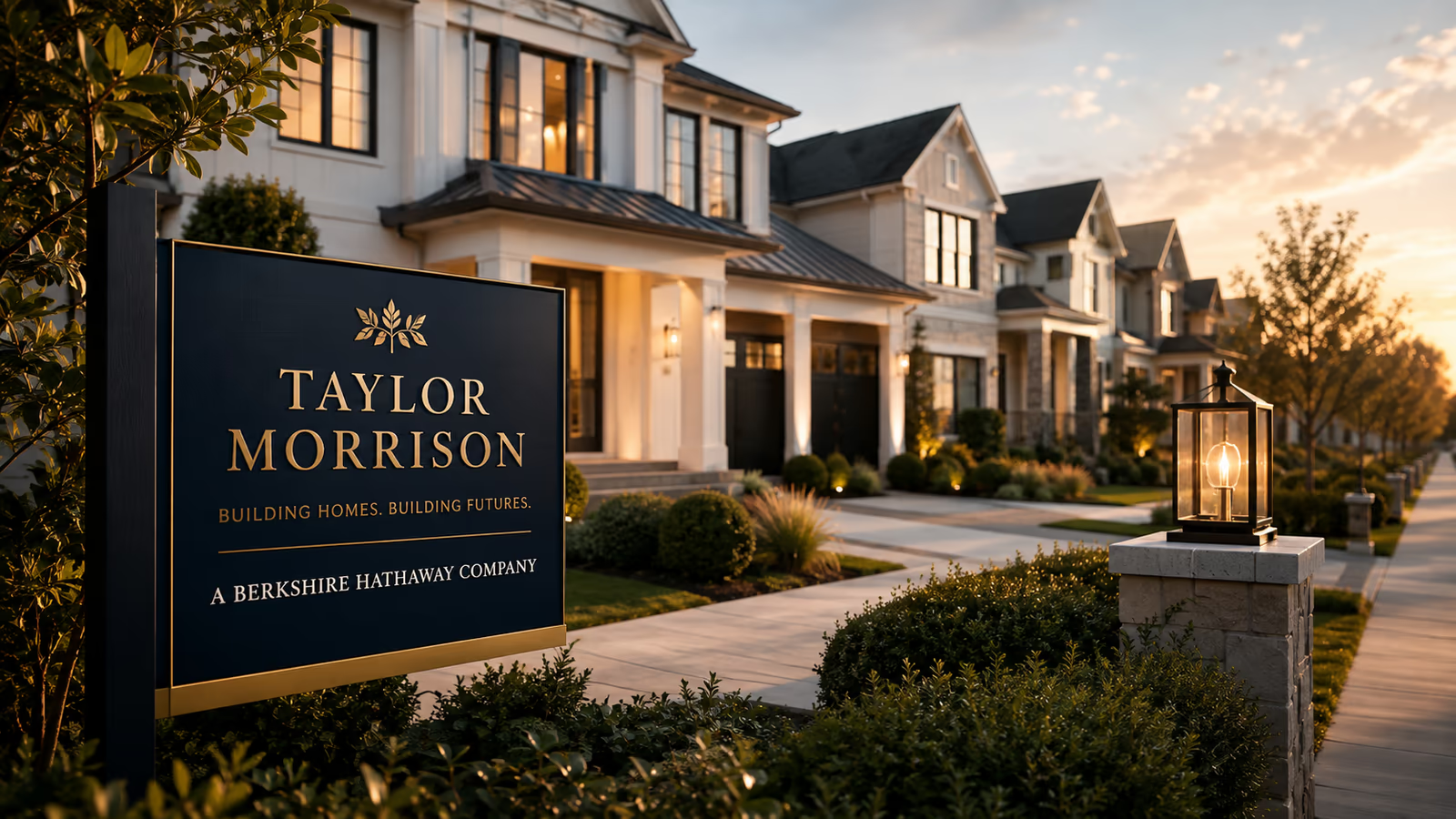
Taylor Morrison probably means nothing to most European investors. Yet the company delivered nearly 13,000 homes in the United States in 2025, posted $8.12 billion in revenue and earned $782.5 million in net income. It develops land, builds houses, finances part of its buyers, sells them title and insurance, and runs a business building homes designed to be rented.
Since 24 July 2026, it has belonged to Berkshire Hathaway. The group paid $72.50 per share, or roughly $6.8 billion in cash. Enterprise value, including net debt assumed, comes to $8.5 billion.
The price, though, is not the most interesting part of the announcement. Berkshire already owned fifteen regional builders, gathered in Clayton Properties Group. Rather than absorbing Taylor Morrison into that organisation, it does close to the opposite: Sheryl Palmer, Taylor Morrison's chief executive, takes responsibility for integrating the whole.
In other words, Berkshire is not merely buying more homes to build. It is buying a national platform, and handing it the conductor's baton.
To understand the deal, first open up Taylor Morrison
An American homebuilder is not a company that merely employs workers to put up houses. The business starts far earlier: identifying the right markets, securing land, obtaining permits, designing neighbourhoods, marketing the homes, building them, then guiding the buyer through financing to the handover of keys.
Taylor Morrison covers almost all of that chain. In 2025 it delivered 12,997 homes at an average price of $597,000. Home sales alone brought in $7.76 billion; land sales, financial services and other revenue take the total to $8.12 billion.
Lots owned or controlled
54 % are controlled off balance sheet, tying up less capital than buying every plot outright.
Homes delivered in the year
From first-time buyers to move-up customers, through to resort lifestyle communities.
Mortgages originated
$4.1bn of principal, alongside title, escrow and insurance.
Home closings gross margin
Still high, but down from 24.4 % in 2024.
That vertical integration matters. A $597,000 home is not just a one-off sale: Taylor Morrison also captures part of the economics of lending, title and insurance, and, through its Yardly brand, of housing built specifically to be rented. Financial services generated $209.4 million of revenue in 2025.
So what Berkshire has added to an already long collection is a far broader company than a regional builder.
Berkshire was already building homes, but not in the same way
Berkshire has owned Clayton Homes since 2003. The name is best known for factory-built housing. From 2015 onwards, however, Clayton assembled a second business: traditional homes built on site, through successive acquisitions of regional builders.
That business is now gathered in Clayton Properties Group. Before Taylor Morrison, it brought together some fifteen local and regional builders, among them Arbor Homes, Goodall Homes and Mungo Homes. Together, according to figures Taylor Morrison communicated to its employees during the transaction, they had delivered roughly 10,000 homes in 2024 for around $4 billion of revenue, largely to first-time buyers, at an average price of about $400,000.
Taylor Morrison brings exactly what that mosaic lacked: a national brand, a presence in the major residential markets, and a far stronger position in the move-up and premium segments.
Clayton Properties Group
Regional and local, owned since 2015, positioned mostly on first-time buyers, organised around local brands. Strong ground-level expertise, but no national brand.
Taylor Morrison
A national multi-market platform, move-up and premium customers, a resort lifestyle segment, rental housing, and mortgage, title, escrow and insurance integrated.
Together, the two platforms delivered close to 23,000 site-built homes in 2025.
Berkshire states that the combination becomes the fourth largest homebuilding operation in the United States. That ranking measures an industrial footprint, in homes delivered, not profitability. Two builders can deliver the same number of homes without carrying the same economic weight.
The heart of the deal may not be that Berkshire almost doubles its site-built volume. It is that the group finally gives that collection a national platform and a single operator.
The real subject of the announcement has a name: Sheryl Palmer
Greg Abel could have kept Taylor Morrison as one more subsidiary in Berkshire's decentralised universe. He could equally have handed the whole to an executive already in place at Clayton.
That is not what he did.
Under Berkshire, Taylor Morrison will continue to be led by chief executive officer Sheryl Palmer, who will oversee the integration of Taylor Morrison's portfolio of brands, including Esplanade, Yardly and Taylor Morrison Home Funding, with Berkshire Hathaway's site-built homebuilding operations that comprise Clayton Properties Group, a collection of fifteen established regional and local homebuilders.
That sentence deserves more attention than the gap between $6.8 billion and $8.5 billion. It says where Berkshire places operational responsibility.
Sheryl Palmer has led Taylor Morrison since 2007. She took the company through the housing crisis, to its stock market listing in 2013, and through seven acquisitions. Two of them illuminate the role she has just been given.
- 2018AV HomesWidens the geographic footprint and opens the offer to first-time buyers and the over-55s.
- 2020William Lyon HomesAround $2.5bn. Opens the Pacific Northwest and strengthens the West.
- 2026Berkshire HathawayPalmer is given Taylor Morrison, and the integration of fifteen builders already owned by her new shareholder.
The parallel with Berkshire's philosophy is instructive. The group likes to leave autonomy to executives it judges capable. Here, decentralisation does not mean keeping fifteen builders with no common architecture: it means choosing one operator and entrusting them with a set of assets that already existed.
For a Berkshire shareholder, that is probably the most important change in the deal. The group is not only adding Taylor Morrison to its perimeter: it is reorganising its exposure to American housing around a team that has already shown it can integrate acquisitions.
Why expand a business whose profits are falling
The timing deserves attention, but not romance.
The American housing market is in no state of euphoria. High mortgage rates weigh on affordability, demand hesitates, and builders lean harder on sales incentives.
Clayton Homes pre-tax profit
First half of 2026, down roughly 5.9 % year on year, on $6.3bn of revenue up 0.9 %. The group attributes the decline to homebuilding, with lending holding up better.
Home closings gross margin
Financial year 2025, against 24.4 % in 2024. The company points to heavier sales incentives and a less favourable mix in some markets.
Three weeks after that half-year closed, Berkshire signed a $6.8 billion cheque to expand precisely that business.
Precision is needed on what this juxtaposition allows. Both facts coexist, both are published by the same company in the same document, and that company does not explain the link between them. One cannot conclude that Berkshire is betting on a housing recovery: no public document carries that claim. Buying into a weaker market is neither proof of contrarian genius nor an inconsistency. For a company that thinks in decades, the strategic question may simply be independent of the next quarter of home sales.
What $6.8 billion represents inside Berkshire
The announcement mentions $6.8 billion of equity value and $8.5 billion of enterprise value. Both figures are accurate and they do not measure the same thing: the first is the cheque paid to shareholders, the second adds the net debt assumed with the company. When a deal is summed up by a single number, it is worth checking which of the two was chosen.
For a Berkshire reader, another comparison speaks louder. At 30 June 2026, the group's insurance operations held roughly $359.2 billion in cash, equivalents and US Treasury bills.
In Berkshire's universe, $6.8 billion remains a considerable investment, but not an existential bet. That is what allows the group to do two things at once: transform an already significant residential business, and keep liquidity far above its running needs. The quarterly report also recalls the rule Berkshire sets itself, not to repurchase shares if doing so would take its cash and Treasury bills below $30 billion. The constraint remains a long way off.
This deal does not stand alone. It belongs to a year in which capital allocation is markedly more active than in the ones before.
A company deploying $16.5 billion in acquisitions in a single year, and $4.8 billion in buybacks in a half, is not in the posture of one accumulating cash without using it.
What actually changes for a Berkshire shareholder
A far broader residential exposure
The combined business now serves renters, first-time buyers, move-up customers and a resort lifestyle segment, across 21 states and 52 markets. The group no longer touches one slice of the housing market: it covers its width.
A national platform, no longer a collection of builders
Clayton Properties brought local depth. Taylor Morrison brings a national brand, integrated financial services and a common management layer. That is the difference between owning fifteen companies and running a platform.
A governance decision as weighty as the acquisition
Berkshire is entrusting Taylor Morrison's team with the integration of assets it already held. The outcome of the deal will therefore depend as much on organisational execution as on the housing market.
The number made the headlines, the org chart says more
Reducing Taylor Morrison to a $6.8 billion cheque means missing almost everything that makes the deal interesting for a Berkshire shareholder.
The group already had a substantial site-built homebuilding business. It was made up of fifteen mostly regional builders, positioned lower on price, organised around local brands. Taylor Morrison brings another dimension: nearly 13,000 homes a year, a national brand, wealthier customers, an integrated financial business and long practice at acquisitions.
And Berkshire is not merely adding that platform to its portfolio. It is handing it the assets it already owned.
Which is why the most interesting asset bought on 24 July may be neither a house, nor a plot of land, nor even a brand. It is a team's ability to turn a collection of builders into a coherent national platform.
The next checkpoint has a date. Berkshire states that Taylor Morrison will be included in its building products group from 24 July 2026. The third-quarter report will therefore be the first to carry the whole. It will not deliver a verdict on the ambition, but it will open a new reading of Berkshire: a group that has become, almost in a single move, the fourth largest homebuilder in the United States by volume, and that has chosen who holds the keys.
Sources
- Berkshire Hathaway, "Berkshire Hathaway Completes Acquisition of Taylor Morrison", 24 July 2026
- Berkshire Hathaway, Form 10-Q at 30 June 2026, filed 10 August 2026
- Taylor Morrison, fourth quarter and full year 2025 results, 11 February 2026
- Taylor Morrison, Form 10-K for financial year 2025
- Berkshire Hathaway, "Berkshire Hathaway Inc. Completes Acquisition of OxyChem", 2 January 2026
- Taylor Morrison, close of the William Lyon Homes acquisition, 6 February 2020